What If inknbox Turned ESSE Studios’ Editions Into a Private Wardrobe Lifecycle Engine to Unlock Up to 40% More Revenue?
- Lifecycle Marketing
- 45 Minutes
A strategic “What If” lifecycle marketing case study for ESSE Studios
Independent case study disclaimer
This is an independent strategic case study created by inknbox. inknbox does not claim to manage ESSE Studios, and this document is not intended to criticize the brand, its internal team, or any current agency partner. It is part of the inknbox “What If” series and is based on the public website experience, visible product and category structure, publicly available brand coverage, and the supplied Brand Prospect Research audit. No private Shopify, Klaviyo, customer, revenue, advertising, inventory, or analytics data was accessed. Every uplift figure, threshold, timing rule, and program design is a hypothetical strategic model that would require validation against ESSE’s actual data, operational capacity, legal requirements, and brand direction.
ESSE Studios already has the difficult part: a distinctive commercial philosophy that naturally supports retention. The brand does not frame each release as a disposable seasonal reset. Its slow-release Editions are designed to build on one another, turning individual garments into an evolving wardrobe system.
That philosophy creates a rare lifecycle advantage. Most fashion brands have to invent a reason for a customer to return. ESSE already has one: the next Edition should add meaning to what the customer already owns. The strategic gap is not simply campaign volume. It is translating that product logic into a one-to-one customer journey across email, selective SMS, inventory alerts, private-client service, referral, and Meta retargeting.
The central question is therefore:
The What If question
What if ESSE’s lifecycle marketing behaved exactly like its Editions – remembering what a customer viewed, understanding what she bought, knowing what works with it, and presenting the next addition as part of a long-term wardrobe rather than another generic launch?
Under this model, Klaviyo would become the central customer relationship layer. It would connect product interest, size, silhouette preference, occasion intent, geography, owned garments, Edition history, engagement, full-price behavior, inventory sensitivity, and private-client status. Email would feel like a digital wardrobe editor. SMS would be reserved for time-sensitive private access. Meta audiences would reinforce the same product and lifecycle logic instead of running separately.
Overview
ESSE’s lifecycle opportunity sits at the intersection of high consideration, strong product continuity, premium storytelling, low-volume scarcity, and a need to protect the direct brand relationship in a hybrid DTC and wholesale model.
ESSE is not a conventional fast-fashion retention problem. A customer considering a tailored blazer, trench, trouser, or occasion dress at a premium price may return several times, compare silhouettes, inspect measurements and materials, ask about sizing, think through styling, and evaluate whether to buy directly or through a prestige stockist. That makes lifecycle marketing less about immediate promotional pressure and more about helping the customer reach confidence.
Once a purchase happens, the retention opportunity becomes even stronger. Because every Edition is intended to work with the previous one, ESSE can build a customer-specific ownership graph: what she owns, which category it belongs to, the size and color purchased, the Edition it came from, the silhouettes it complements, and the next pieces that would expand its use. This is the foundation of The ESSE Wardrobe – a digital relationship that becomes more valuable after every purchase.
Growth Area | Lifecycle Opportunity for ESSE |
New visitor conversion | Replace a passive “Join Us” field with a private-access proposition built around Edition previews, wardrobe notes, fit guidance, restocks, and Atelier invitations. |
First purchase activation | Route education by exact product, category, size uncertainty, occasion, and geography so the customer receives confidence rather than generic urgency. |
Repeat purchase growth | Use owned-SKU and Edition history to recommend what the next release adds to garments already in the customer’s wardrobe. |
Loyalty and private-client growth | Recognize multi-Edition owners, full-price repeat buyers, high-LTV customers, and Atelier-engaged customers with reserved access and service – not only points or discounts. |
Average order value | Extend the site’s visible “Pair with” logic into complete-look recommendations, product bundles by styling intent, and post-purchase wardrobe expansion. |
Long-term retention | Turn care, construction, local manufacturing, styling, founder perspective, and editorial credibility into an ongoing ownership experience. |
Paid media efficiency | Sync Klaviyo behavioral segments to Meta so ads reinforce the same viewed product, saved size, Edition interest, or next-best addition. |
DTC relationship protection | Give customers reasons to stay connected directly to ESSE even when the same label is available through Net-a-Porter, SSENSE, Harrods, Harvey Nichols, and other premium stockists. |
Klaviyo’s role: a wardrobe CRM, not a broadcast tool
Klaviyo should not merely decide who receives the next newsletter. It should maintain and act on a progressively richer profile:
what the customer viewed, saved, carted, and purchased;
whether she returns to tailoring, dresses, outerwear, or wardrobe essentials;
her likely size, fit uncertainty, color preference, and silhouette affinity;
the ESSE products and Editions she already owns;
whether she shops full price, waits for sale, or responds to scarcity;
whether she is local to Sydney, elsewhere in Australia, in the United States, or in another international market;
whether she needs shipping, duties, returns, or fit reassurance;
whether she has private-client, appointment, or modern-ceremony intent;
how recently and frequently she engages across email, SMS, site, and paid media.
That data allows ESSE to replace a product-grid rhythm with a customer-specific sequence: You considered this. Here is how it fits. Here is how it is made. Here is what works with it. Here is what the latest Edition adds to what you already own.
ESSE Studios’ Background
The brand’s public positioning, product structure, and distribution model create both the need and the material for a premium lifecycle system.
Category | Details |
Brand positioning | A contemporary luxury womenswear house centered on intentional luxury, seasonless design, conscious consumption, and garments intended to remain relevant over time. |
Founder and origin | Sydney-founded and led by Charlotte Hicks, whose public brand narrative connects design restraint with frustration toward excess and waste in fashion. |
Core product type | High-consideration ready-to-wear rather than consumable or routine-refill products. Retention comes from wardrobe expansion, new Editions, occasions, styling, care, and private-client relationships. |
Main product categories | Tailoring, blazers, trousers, dresses, shirts and tops, knitwear, coats and trenches, scarves and accessories, gift cards, and curated Edition drops. |
Brand communication style | Restrained, editorial, architectural, product-led, and premium. The strongest lifecycle copy should feel considered and specific, never noisy or over-promotional. |
Customer behavior type | Multi-session research, fit and material evaluation, occasion planning, style comparison, low-stock sensitivity, and long purchase intervals relative to lower-priced fashion. |
Commercial model | Hybrid direct-to-consumer plus prestigious wholesale distribution. This expands reach but means ESSE’s own store must earn the direct relationship through service, access, memory, and personalization. |
Core revenue opportunity | Convert more high-intent visitors, recover consideration with product-specific confidence, increase second and third purchases, and make each new Edition personally relevant to existing owners. |
Retention potential | High for a non-consumable label because the product philosophy is deliberately cumulative: each Edition is designed to work with the last. |
Ideal automation structure | Product- and category-specific acquisition, confidence-led abandonment, ownership-aware post-purchase, Edition continuity, low-stock and waitlist alerts, private-client progression, and region-specific support. |
Public product signals and their lifecycle implications
The following public examples illustrate the breadth of intent ESSE’s CRM should distinguish. Prices and availability are snapshots from the review date and should be dynamically sourced from the live catalog in production.
Product example | Public price example | Likely customer intent | Lifecycle use |
Taro Trench | A$1,590 | Investment outerwear, layering, seasonless polish, silhouette confidence | Longer browse window; fit education; low-stock branch; care and layering content; cross-sell to trousers and tailoring. |
Alessio Blazer | A$1,190 | Modern tailoring, work-to-evening dressing, structured wardrobe foundation | Tailoring affinity; fit and construction proof; pair with Issia Trouser; private-client styling path. |
Mila Dress | A$890 | Occasion, modern ceremony, event dressing, elevated minimalism | Occasion-date capture; size support; event-timed nurture; accessories and future-wear reassurance. |
Issia Trouser | A$590 | Foundational tailoring, workwear, repeatable wardrobe use | Entry product for The ESSE Wardrobe; strong blazer, shirt, knit, and trench expansion logic. |
The direct relationship challenge
Prestige wholesale validates the brand, but it also creates a structural retention challenge: a customer can discover ESSE through the brand and still purchase the same label from a multi-brand retailer. Discount parity alone will not protect the DTC relationship. The direct store needs benefits a marketplace cannot easily replicate:
a remembered ESSE wardrobe;
reserved sizes and waitlist priority;
product and Edition recommendations based on prior ownership;
direct fit help and Atelier access;
founder and making-of content;
private previews, event invitations, and pre-order opportunities;
coordinated care, styling, and new-Edition continuity after purchase.
Strategic implication |
A conversion-confidence issue to resolve before scaling recovery
The supplied audit found conflicting shipping and returns information across the dedicated policy page, FAQ/contact content, and selected product-page messaging. The public review showed different international shipping figures and different return-request windows depending on the page. At premium order values, that inconsistency can create hesitation precisely when browse and checkout recovery are trying to build confidence.
Before aggressively scaling abandonment automation, Phase 1 should establish a single source of truth for delivery cost, duties, timing, returns, and exchanges. Klaviyo dynamic content should pull from the same approved regional policy matrix used on the site. This is not a cosmetic cleanup. It is part of the conversion system.
Public research signals summarized here include the ESSE homepage positioning, About narrative, Sustainability page, Stockists page, Shipping and Returns page, FAQ/contact content, and selected Taro Trench, Alessio Blazer, Issia Trouser, and Mila Dress product pages reviewed September 4, 2026.
The Core Growth Hypothesis
The strongest revenue hypothesis is not “more email.” It is a one-to-one Edition system that increases confidence before purchase and relevance after purchase.
Growth hypothesis
Our hypothesis is simple: ESSE Studios could unlock up to 40% additional lifecycle-driven revenue if its customer journey were rebuilt around product intent, fit confidence, geographic reassurance, owned-garment memory, Edition continuity, private-client progression, selective scarcity, and coordinated email, SMS, referral, and Meta retargeting.
The 40% figure is a directional upside scenario, not a forecast. It assumes meaningful gaps exist between ESSE’s current public-facing lifecycle experience and a fully implemented system; it also assumes healthy site traffic, deliverable inventory, reliable event tracking, creative capacity, and disciplined optimization. Actual impact could be lower or higher and must be measured against ESSE’s private baseline.
Revenue Lever | Expected Role in the ESSE Model |
Welcome flow optimization | Turn a minimal signup into a premium onboarding path that explains Editions, local making, category entry points, and private access. |
Browse abandonment | Return visitors to the exact product or category they considered, with fit, construction, styling, stock, and region-specific information. |
Cart and checkout recovery | Resolve the customer’s real objections – size, delivery, duties, returns, styling, and investment confidence – before considering an incentive. |
Post-purchase education | Reduce uncertainty, support care and styling, increase satisfaction, and create a bridge from the first garment to the next relevant addition. |
Edition continuity automation | Show existing owners what a new Edition adds to the exact ESSE pieces already in their wardrobe. |
Private-client progression | Convert repeat and high-value behavior into early access, reserved sizes, styling service, appointments, and recognition. |
Cross-sell and complete-look logic | Increase AOV and LTV through owned-SKU-aware pairings rather than generic recommendations. |
SMS private access | Use text only for restocks, low inventory, early access, appointment reminders, and genuinely time-sensitive private-client moments. |
Referral | Acquire high-fit customers through trusted introductions while protecting luxury positioning with controlled, service-led benefits. |
Meta retargeting audiences | Reinforce the same product, category, size, Edition, and lifecycle message outside the inbox. |
Winback and sunset | Reconnect lapsed owners through wardrobe relevance while suppressing disengaged profiles to protect deliverability. |
No single flow creates the outcome. The impact comes from the combined effect of more valuable list growth, better first-purchase conversion, improved recovery, stronger direct retention, higher second-purchase relevance, selective AOV expansion, and paid media that uses the same customer intelligence.
Why 40% is strategically believable – but not guaranteed
ESSE has several characteristics that justify a meaningful upside scenario:
- High AOV and long consideration. Small improvements in conversion and recovery can produce meaningful revenue per recovered customer.
- A visible acquisition gap. The public signup proposition is restrained and does not clearly explain subscriber value.
- A differentiated retention story. Editions provide a natural framework for personalized repeat purchase without constant discounting.
- Strong content supply. Founder perspective, local manufacturing, runway/editorial signals, fit notes, materials, care, and styling can support education-led selling.
- Scarcity and size availability. Low-stock, restock, waitlist, and alternative-style logic can monetize demand that would otherwise disappear.
- Direct-versus-wholesale tension. Better DTC service and memory can protect direct repeat purchasing.
The upside is moderated by the fact that luxury ready-to-wear is not a short-cycle consumable category. Purchase frequency is naturally lower, sizes and inventory constrain conversion, and heavy discounting would damage the brand. The strategy therefore prioritizes confidence, service, relevance, and relationship depth.
Priority-Based Tools & Automation Infrastructure
The system depends on clean commerce events, a disciplined customer property model, live catalog and inventory logic, and coordinated activation across owned and paid channels.
Layer | Tool / System | Purpose |
Core CRM | Klaviyo | Email, selective SMS, flows, segments, dynamic content, campaign orchestration, profile properties, and revenue attribution. |
Commerce platform | Shopify storefront and commerce events, subject to technical validation | Product views, add-to-cart, checkout, orders, refunds, returns, SKU, size, color, price, discount, and customer events. |
Product and ownership layer | Klaviyo catalog plus an ESSE product relationship map | Connect every SKU to category, Edition, silhouette, color family, material, complementary products, and “works with” relationships. |
Inventory and waitlist | Native or integrated back-in-stock and low-stock system | Size-specific waitlists, restock alerts, low-stock triggers, alternative-size and alternative-style routing. |
Customer data layer | Klaviyo profile properties | Size, region, category affinity, owned garments, Edition ownership, occasion intent, style preference, full-price behavior, and private-client stage. |
Fit and service layer | Fit notes, measurements, customer-service tags, appointment data | Route fit education, human support, Atelier follow-up, return-risk suppression, and service recovery. |
Review and UGC layer | Review/UGC platform integrated with Klaviyo | Product-specific proof, review requests, fit feedback, styling stories, and advocacy triggers. |
Loyalty / private client | Lightweight loyalty or custom tier logic | Recognition, early access, reserved sizes, appointment benefits, pre-order opportunities, and referral rewards. |
Analytics | Klaviyo analytics, GA4, Shopify reports, and a lifecycle dashboard | Flow revenue, customer movement, cohort repeat purchase, direct repeat share, AOV, LTV, deliverability, and Meta audience performance. |
Retargeting | Meta Ads custom audiences synced from Klaviyo | Product-specific recovery, Edition launch relevance, private-client conversion, winback, and customer exclusions. |
Lead capture | Onsite forms, saved-edit forms, quiz/guide landing pages | Email and SMS consent, size and preference capture, category intent, region, occasion, and first-party audience growth. |
Referral | Referral or loyalty tool with fraud and return-window controls | Track introducer, referred customer, qualifying order, benefit delivery, and exclusions. |
The customer properties ESSE should collect
The first-party data model should be intentionally small at capture and progressively enriched by behavior. A new visitor should not face a long form. The system can infer and append properties over time.
preferred_size | size_confidence_level |
fit_preference | category_affinity |
silhouette_affinity | color_palette_affinity |
occasion_intent | modern_ceremony_interest |
outerwear_interest | tailoring_interest |
region | currency |
duties_reassurance_needed | preferred_store_or_atelier |
appointment_interest | last_product_viewed |
last_category_viewed | most_viewed_sku_30d |
saved_edit_items | wishlist_count |
low_stock_interest | waitlist_sku_size |
last_product_purchased | owned_skus |
owned_editions | purchase_count |
lifetime_value_band | full_price_share |
discount_dependency_band | return_rate_band |
private_client_stage | email_engagement_score |
sms_opt_in_status | referral_status |
next_best_product | next_edition_relevance |
Why product, size, and Edition logic matter
- A fashion CRM that only stores “purchased” misses the commercial structure. ESSE needs to know what was purchased and what it means:
- An Issia Trouser purchase signals tailoring affinity and creates blazer, shirt, knit, and trench pairings.
- A Mila Dress purchase may signal occasion intent, modern-ceremony interest, a date-sensitive need, and a stronger requirement for fit confidence.
- A Taro Trench purchase signals investment outerwear and creates a longer care and layering path.
- A shopper repeatedly viewing size 8 in a low-stock garment needs a different message from a casual category browser.
- A customer who owns pieces from Editions 13, 14, and 15 should receive a new-Edition message that references continuity, not the same launch email sent to a first-time subscriber.
- This requires a maintained product relationship map. Each SKU should carry tags such as edition, category, silhouette, occasion, fabric, color_family, fit_profile, investment_level, works_with, alternative_to, and care_story. Klaviyo can then render dynamic blocks from the map while suppressing anything already owned or unavailable in the customer’s likely size.
Why Klaviyo-to-Meta sync matters
Luxury consideration rarely happens in one session or one channel. A customer may view a blazer, leave, open a fit email, return through Instagram, compare a retailer, and complete the purchase days later. Klaviyo segments should therefore sync to Meta so the paid message matches the owned-channel stage.
A Taro Trench browser should see the Taro story, not a generic new-arrivals ad. An existing Issia Trouser owner should see how the next Edition builds on her tailoring. A customer in checkout recovery should be excluded from broad promotional ads and shown confidence-led creative. A VIP should be excluded from acquisition discounting and shown private access.
Lifecycle Architecture Design
Every customer should move through a controlled journey based on intent, ownership, value, and timing – not remain in one undifferentiated newsletter list.
Lifecycle Stage | Main Goal | ESSE Strategy |
Acquisition | Capture permission and meaningful first-party data | Private-access forms, saved edits, Wardrobe Notes, size and category preference, occasion intent, and region-aware signup. |
Activation | Convert subscribers and first-time buyers | Editions education, exact-product recovery, fit and shipping confidence, founder/craft proof, service access, and first-purchase guidance. |
Retention | Increase satisfaction and relevant repeat purchase | Styling, care, product ownership memory, Edition continuity, waitlists, new-Edition matching, and next-addition timing. |
Expansion | Increase customer lifetime value and advocacy | Complete-the-Edition recommendations, private-client progression, reserved access, referral, occasion expansion, VIP events, and paid audience coordination. |
How a customer moves through the system
- First visit: onsite behavior establishes a category and product-intent signal. The lead form asks only for email; a second step optionally asks size, wardrobe focus, region, and SMS consent.
- Welcome: the content path changes according to whether the visitor is interested in tailoring, occasion dressing, outerwear, or general wardrobe foundations.
- Consideration: browse and checkout flows use exact product, size, fit, material, stock, and regional policy content. The customer is offered human help before a discount.
- Purchase: the profile records SKU, size, color, Edition, price behavior, category, and delivery region. First-purchase conversion messages stop immediately.
- Ownership: post-purchase education changes by garment. The system teaches fit, styling, care, and how the piece lives with other Editions.
- Next addition: new releases and cross-sell flows match the customer’s owned wardrobe. Already-owned and unavailable products are suppressed.
- Private-client progression: repeat, full-price, multi-Edition, high-LTV, and Atelier-engaged customers enter a service-led recognition path.
- Reactivation or suppression: lapsed owners receive a wardrobe-relevance winback. Unengaged non-buyers receive a preference and sunset sequence to protect deliverability.
Core routing hierarchy
When several messages could be sent, the system should prioritize the customer’s highest-intent or highest-service need:
Priority | Customer State | Message Priority |
1 | Return, exchange, delivery, or service issue | Human service and resolution; suppress sales automation. |
2 | Started checkout, no purchase | Exact-product checkout confidence and assistance. |
3 | Added to cart, no checkout | Saved-edit reminder, fit and stock support. |
4 | Size-specific waitlist or back-in-stock event | Time-sensitive availability alert. |
5 | Recent purchase | Post-purchase education and care; suppress first-purchase and aggressive cross-sell. |
6 | New Edition relevant to owned garments | Ownership-aware launch path. |
7 | High-intent browse | Exact-product or category education. |
8 | Private-client or VIP | Early access, appointment, and reserved-size communications. |
9 | General engaged subscriber | Segmented editorial and product campaigns. |
10 | Unengaged subscriber | Re-engagement, preference collection, and sunset. |
Operating rule |
Lead Capture Strategy
The acquisition proposition should feel like entry into the ESSE world, not a generic discount exchange.
1. Website Popup and Embedded Form System
The supplied audit found a visible footer signup that essentially asks the visitor to “Join Us” without explaining the value of joining. The solution is not necessarily a first-order discount. For a premium label, the form itself should communicate access, service, and editorial value.
Visitor Behavior | Lead Capture Strategy |
First-time visitor, 8-12 seconds or 35% scroll | Present the primary proposition: Edition previews, wardrobe notes, restocks, and Atelier invitations. Ask only for email first. |
Tailoring browser | Offer “The ESSE Tailoring Notes” and capture likely size plus interest in blazers, trousers, or complete suiting. |
Dress or occasion browser | Offer “The Modern Ceremony Edit” and optionally capture event type, event month, and size. |
Outerwear browser | Offer early restock and low-stock alerts plus a concise layering and fit guide. |
Returning visitor | Restore the last-viewed or saved product and ask whether the visitor wants to save the edit or receive size availability alerts. |
Exit-intent visitor | Offer the Wardrobe Notes or saved-edit email rather than an immediate site-wide discount. |
Email plus SMS signup | Invite the subscriber to “ESSE Private Access” for early Edition access, size restocks, low-stock notices, and Atelier reminders. |
Existing subscriber | Do not show the acquisition form. Show a preference, save-to-edit, waitlist, or appointment prompt instead. |
Primary popup concept
Headline: Build Your ESSE Wardrobe
Supporting copy: Private access to new Editions, wardrobe notes, restocks, and Atelier invitations – curated around the pieces you return to.
Primary CTA: Join the ESSE List
Second-step CTA: Add mobile for ESSE Private Access
Form logic
Step 1: email address.
Step 2: optional mobile number with clear, region-appropriate consent language.
Step 3: one preference question – “Where would you begin?” with Tailoring, Dresses and Occasion, Outerwear, or Wardrobe Foundations.
Progressive enrichment later: likely size, region, fit preference, event timing, and appointment interest.
Frequency cap: do not interrupt every session; suppress for subscribers, purchasers within the last 14 days, open service cases, and visitors who dismissed the form recently.
Mobile experience: use a compact bottom sheet, not a full-screen takeover that competes with the editorial design.
SMS consent must be explicit, unbundled where required, and accompanied by message-frequency, carrier, privacy, and opt-out language appropriate to each region. SMS should never be preselected or treated as a condition of email signup.
2. Paid Ads Lead Capture Landing Page
The strongest low-friction lead magnet is not a percentage-off coupon. It is a brand-aligned decision tool:
Lead magnet
Find Your ESSE Starting Point
A concise wardrobe guide that helps a visitor identify the right first category, silhouette, and styling path – then delivers a personalized ESSE edit by email.
The landing page should include:
the Editions concept and why each release is designed to build on the last;
four entry paths: Tailoring, Wardrobe Foundations, Outerwear, and Modern Ceremony;
a short visual-free quiz using silhouette, use case, and fit preferences;
one recommended starting product or category, subject to live availability;
an optional size field and region field for relevant guidance;
email delivery of the personal edit;
an optional SMS step for private access, not a forced upsell;
a direct best-fit collection CTA after signup;
exclusion of recent purchasers, existing subscribers, and current checkout abandoners from acquisition ads.
The objective is not only immediate purchase. A cold Meta visitor may not buy a premium garment after one impression, but she may exchange permission for a useful, beautifully framed wardrobe recommendation. That converts rented attention into an owned relationship that Klaviyo can nurture over multiple sessions.
3. Referral Entry Point
Referral should be present as an invitation inside the ownership journey, not hidden in a footer. The benefit must be controlled so it protects full-price positioning.
User Type | Example Test Offer |
Referred friend | A private welcome benefit such as complimentary express delivery in Australia or an A$75 wardrobe credit on a first full-price order above a defined threshold, with regional equivalents and exclusions. |
Existing customer | An A$100 wardrobe credit, Atelier styling benefit, or reserved-access benefit after the referred order is retained beyond the return window. |
These are test concepts, not recommendations to launch without margin, legal, fraud, and brand review. A service-led or shipping-led benefit may outperform a discount while preserving luxury cues.
Referral triggers: after a second retained purchase; after a positive review; after private-client qualification; after a successful Atelier appointment; after a new-Edition repeat purchase; after a styling or UGC contribution; and after a referred order clears the return window.
Referral message
Introduce someone to ESSE.
Invite a friend to begin her wardrobe with a private welcome benefit. Once her first full-price piece becomes part of her wardrobe, your next ESSE addition will be recognised too.
Core Klaviyo Flow System
Ten interconnected flows would convert attention, protect consideration, improve ownership, and make the next Edition personally relevant. Product routing, suppression, and service logic are as important as the message sequence itself.
The following flows are strategic blueprints. Exact delays, channel mix, entry thresholds, frequency caps, and incentives must be validated against ESSE’s real event volume, customer cohorts, fulfillment windows, return behavior, legal requirements, and creative resources.
Below is a curated selection of email design concepts illustrating how the proposed Klaviyo flow system could be translated into a cohesive, conversion-focused customer experience. While the complete lifecycle strategy includes several additional flows, this preview highlights three core sequences: four selected emails from the seven-email Welcome Flow, one email from the three-email Browse Abandonment Flow, and one email from the three-email Checkout Abandonment Flow. The remaining flows would be developed with equally tailored, brand-aligned email designs to ensure consistency across the full lifecycle marketing system.
Flow Breakdown by Lifecycle Stage
Welcome Flow
Purpose: Convert new subscribers into first-time buyers while teaching the Editions philosophy, establishing product preference, and making the direct relationship feel valuable before any promotion is used.
Entry criteria: Subscribed to email through onsite form, paid lead page, saved edit, event, or Atelier source; has not purchased; is not already active in a higher-priority service or checkout flow.
Exit and suppression: Exit on purchase and route immediately into the correct post-purchase branch. Suppress recent purchasers, open service cases, hard bounces, unsubscribed profiles, and profiles already in a duplicate welcome path. SMS messages require separate consent.
Message | Timing | Purpose and Content |
Email 1 | Immediately | Welcome to ESSE. Explain intentional luxury and the idea that each Edition builds on the last. Confirm the value of joining: previews, wardrobe notes, restocks, and private access. CTA routes to the preference selected at signup. |
Email 2 | +1 day | How the Editions work. Show that the customer is not shopping isolated seasons; she is beginning an evolving wardrobe. Introduce the concept of pieces designed to work together across releases. |
Email 3 | +3 days | Made in Sydney. Tell the local production, specialist-maker, fabrication, and construction story. Use product-level examples instead of broad sustainability claims. |
Email 4 | +5 days | Choose your starting point. Dynamic path for Tailoring, Dresses and Occasion, Outerwear, or Wardrobe Foundations. Ask for size and fit preference only if not already known. |
Email 5 | +7 days | Confidence before purchase. Fit notes, garment measurements, regional delivery and returns guidance, human sizing help, and the ability to reply. Pull the exact product most viewed since signup. |
Email 6 | +10 days | The ESSE Wardrobe. Present a complete three-piece edit around the subscriber's strongest category affinity. Explain why each addition increases the use of the others. |
Email 7 | +14 days | Your next considered step. Personal recommendation based on views, clicks, size, region, and stock. For low-intent subscribers, offer the Wardrobe Notes; for high-intent subscribers, restore the exact product or saved edit. |
Segmentation and content routing:
Signal | Welcome Path |
Tailoring selected or blazer/trouser clicks | Lead with Alessio Blazer, Issia Trouser, structured shirts, and complete-suiting logic. |
Dress or occasion selected | Lead with Mila Dress and other event-ready silhouettes, fit support, and the Modern Ceremony Edit. |
Outerwear selected | Lead with Taro Trench, layering, investment rationale, care, and stock/size availability. |
No declared preference | Use browsing during the first 72 hours to set category_affinity; otherwise present four restrained entry points rather than a large product grid. |
International region | Insert delivery timing, duties explanation, sizing conversion, and returns reassurance from the approved regional policy matrix. |
Sydney/local interest | Insert Atelier, click-and-collect, same-day delivery where available, and appointment options. |
High-intent product viewer | Replace generic Email 7 with the exact product, current stock by selected size, fit note, and human assistance. |
No engagement after Email 3 | Reduce frequency, test a founder/editorial subject line, and avoid escalating to SMS. |
Incentive rule: Do not default to 10% off. First test access, service, saved edits, fit help, complimentary shipping thresholds, or a tightly controlled private welcome benefit. Discounting should be a later, segment-specific experiment for price-sensitive non-buyers, not the brand's universal introduction.
Browse Abandonment
Purpose: Bring back visitors who viewed a specific product or category without adding to cart, using the information most likely to reduce uncertainty for that exact consideration.
Entry criteria: Viewed the same product at least twice within seven days, or viewed a high-consideration PDP and spent a meaningful dwell time; no add-to-cart, checkout, or purchase after the qualifying view; email permission is present. A lighter one-view path can be tested only for highly engaged subscribers.
Exit and suppression: Exit on add-to-cart, checkout, purchase, out-of-stock status in the likely size, open return/service issue, or entry into a higher-priority flow. If the item sells out, route to size-specific waitlist or alternative-style content rather than continuing a dead-product sequence.
Message | Timing | Purpose |
Email 1 | 4-6 hours | Restore the exact product. Summarize its design intent, silhouette, and strongest wardrobe role. CTA returns to the exact size/color state where possible. |
Email 2 | +24 hours | Build confidence through fit, measurements, fabrication, construction, care, local making, and one relevant styling combination. Include human help. |
Email 3 | +48-72 hours | Resolve the likely objection: investment value, how it works with existing wardrobe categories, region-specific shipping/returns, social/editorial proof, or a credible alternative. |
SMS, optional | Only on verified low stock or restock | Short private alert tied to the exact product and size. Never send routine browse reminders by SMS. |
Real-product routing examples:
Viewed Product or Category | Content Route |
Taro Trench | Explain the oversized silhouette, layering role, and available fit guidance; show how it completes tailoring; use investment and care content; trigger low-stock messaging only when inventory data confirms it. |
Alessio Blazer | Focus on fitted-waist tailoring, construction, work-to-evening use, and pairing with the Issia Trouser. Offer a sizing reply or appointment rather than a discount. |
Issia Trouser | Position it as a foundation piece; explain wide-leg fit and styling versatility; recommend the Alessio Blazer, a refined top, and the Taro Trench as three distinct looks. |
Mila Dress | Lead with occasion and modern-ceremony use, inner-bodice fit guidance, precise measurements, and the fact that the piece can live beyond one event. Ask whether sizing help is needed. |
Tailoring category | Compare blazer and trouser silhouettes, suggest a starting foundation, and route by workwear, evening, or complete-suiting intent. |
Dresses / occasion category | Route by event type and timing: civil ceremony, rehearsal dinner, reception, evening, or non-bridal occasion. |
Outerwear category | Lead with layering, silhouette, climate, garment care, and how outerwear changes the use of pieces already owned. |
Scarves/accessories | Emphasize styling transformation, gifting, color, and how a smaller addition can connect multiple looks. |
Behavioral personalization:
- A visitor who repeatedly chooses the same size should see that size preselected and receive size-specific availability.
- A visitor who moves between two sizes should receive fit comparison and a reply-to-stylist prompt.
- A visitor who views a product after reading Sustainability should receive making and materials content.
- A visitor who arrives from editorial coverage should receive design context and the relevant Edition, not a generic brand introduction.
- A visitor who previously purchased ESSE should see how the viewed piece works with owned SKUs. New subscribers should see how it functions as a starting point.
- A sale-led visitor should not automatically receive a full-price private-client message; a full-price buyer should not be trained to wait for sale.
Checkout Abandonment Flow
Purpose: Recover high-intent customers by responding to the exact product, size, geography, and objection present at cart or checkout.
Entry criteria: Added to cart or started checkout; no completed order; product remains available or has a valid waitlist/alternative path. Create separate branches for add-to-cart and started-checkout intensity.
Exit and suppression: Exit immediately on purchase. Suppress for service issues, fraud flags, out-of-stock without alternatives, or recent duplicate checkout. If a return/exchange case is open, prioritize service. If the product becomes unavailable in the selected size, send a waitlist or alternative rather than urgency that cannot be fulfilled.
Message | Timing | Message Focus |
Email 1 | 45-90 minutes | Restore the exact cart or checkout. Show product, size, color, and price; provide a frictionless return link; frame it as "Your ESSE edit is saved." |
SMS 1, optional | 3-5 hours | For consented customers who started checkout: a concise saved-checkout reminder with service access. Do not use for every cart abandoner. |
Email 2 | +18-24 hours | Dynamic objection handling: fit, measurements, fabrication, care, regional shipping/duties, returns, payment, or appointment assistance. |
Email 3 | +42-48 hours | Wardrobe value: show two or three ways the exact garment works, including owned products when known. Add public trust signals without overloading the design. |
Email 4 | +72 hours | Genuine availability message if low stock is verified, otherwise a final service-led check-in. Offer an alternative silhouette if the selected size is gone. |
Product-specific objection logic:
Product Type | Likely Objection | Recovery Content |
Premium outerwear | "Will I wear it enough? How does the oversized fit work?" | Cost-per-wear framing without fabricated numbers, layering combinations, size-down guidance where publicly indicated, care, and long-term styling. |
Structured blazer | "Will the waist and shoulder fit? Is it too formal?" | Garment measurements, silhouette notes, styling from work to evening, model fit reference, and direct sizing assistance. |
Wide-leg trouser | "Which size and length? What will I pair with it?" | True-size guidance where appropriate, rise/length details, three pairings, alteration or styling help if available. |
Strapless/occasion dress | "Will the bodice fit? Is it only for one event?" | Exact inner-bodice guidance, measurement support, event-specific styling, and post-event versatility. |
International checkout | "What will delivery, duties, and returns cost?" | Approved region-specific cost and timing, duties treatment, returns process, and customer-service access. No conflicting policy language. |
Incentive sequence:
- Product and checkout restoration.
- Fit and service confidence.
- Construction, styling, longevity, and direct-brand value.
- Genuine stock or deadline information.
- Only then test a controlled benefit for an eligible, price-sensitive segment - never a universal coupon and never for VIP/full-price buyers who do not need it.
Prerequisite |
Post-Purchase Flow
Purpose: Turn a first purchase into confident ownership, reduce avoidable uncertainty, reinforce the garment's value, and prepare the customer for a relevant second purchase without rushing the relationship.
Entry criteria: Order placed. Branch by product category, SKU, size, Edition, customer type, region, and fulfillment state.
Exit and suppression: Continue essential service messages, but suppress sales and referral content when an order is cancelled, refunded, returned, delayed, or under support review. An exchange should update the owned SKU and size before later recommendations are generated.
Timing | Purpose | |
Email 1 | Immediately after purchase | Thank the customer, confirm what happens next, restate the exact product and size, provide service access, and introduce the design intent behind the garment. |
Email 2 | Before delivery | Prepare for arrival: fit expectations, how to try the piece, garment measurements, fabrication, and what to do if help is needed. Regional logistics are pulled from the approved policy matrix. |
Email 3 | 2-3 days after delivery | "How it lives in your wardrobe." Deliver three styling directions specific to the purchased product and likely category affinity. |
Email 4 | +10-14 days | Care and construction. Explain how to preserve shape, fabric, and finish, using product-specific instructions rather than a generic care email. |
Email 5 | +30-45 days | Build on the purchase. Recommend complementary pieces that increase the garment's use, excluding owned, returned, unavailable, or recently viewed-and-rejected products. |
Email 6 | +90 days or next relevant Edition | Show what the latest Edition adds to the customer's exact ESSE piece. This is the first major bridge into the Edition continuity system. |
Product-purchase branches:
Product Purchased | Post-Purchase Angle |
Issia Trouser | Fit and drape; three styling modes; how the Alessio Blazer creates a complete suit; relaxed knit/shirt path; Taro Trench layering; trouser care. |
Alessio Blazer | Shoulder and waist settling; buttoning and layering; pairing with Issia Trouser or relaxed separates; professional and evening styling; structured-garment care. |
Taro Trench | Oversized silhouette; belt and open-layer styling; climate transitions; storage and care; pieces that sit cleanly beneath it. |
Mila Dress | Bodice fit and movement; event styling; outerwear and accessory options; how to restyle after the original occasion; delicate-garment care. |
Scarf or accessory | Multiple styling applications, color pairings, gifting follow-up, and a path into a foundational garment category. |
Multi-piece order | Teach how the pieces work together first, then recommend only the missing layer or category that expands the set. |
Service and return-risk routing:
- If the customer clicks fit-help or replies with uncertainty, create a customer-service task and pause promotional branches.
- If a return is initiated, stop cross-sell and referral messages; begin a service recovery path that asks whether an exchange, alternative size, or different silhouette would be more useful.
- If the customer keeps the item beyond the return window and engages with styling content, increase confidence score and schedule a later review/referral request.
- If the product is a gift, ask the purchaser whether future recommendations should be for the recipient or for the purchaser's own wardrobe.
Replenishment / Repeat Purchase Flow
Purpose: Adapt "replenishment" for a non-consumable luxury label by identifying the next logical wardrobe addition based on owned garments, Edition history, category gaps, occasion timing, and new-release relevance.
Entry criteria: Customer has at least one retained purchase and is not in an immediate post-purchase, return, checkout, or service flow. Trigger from elapsed time, a new Edition, a relevant restock, a captured occasion, or a strong complementary-product signal.
Exit and suppression: Exit on purchase. Suppress recommendations already owned, recently returned, unavailable in likely size, outside the customer's relevant region, or incompatible with stated preferences. Do not force a fixed 30-day reorder cadence; luxury purchase timing should be cohort-based.
Profile Property | ESSE Example |
Last product purchased | Issia Trouser |
Product category | Tailoring / wardrobe foundation |
Size and color | Customer-specific, dynamically stored |
Edition owned | Edition associated with the purchased SKU |
Purchase date | Dynamic |
Complementary product graph | Alessio Blazer, refined top/knit, Taro Trench, relevant future Edition pieces |
Buying-cycle estimate | Based on actual ESSE cohort behavior by first product, spend band, and engagement - not an assumed replenishment period |
Private-client status | Prospect / owner / repeat owner / multi-Edition / private client |
Next relevant event | New Edition, size restock, local appointment, captured occasion, or seasonal styling moment |
Message | Timing Trigger | Purpose |
Email 1 | 30-45 days after retained first purchase | Reinforce use of the owned piece and present one missing wardrobe role, not a broad product grid. |
Email 2 | 60-90 days or strong complementary browse | Show a complete "build on what you own" edit using the owned SKU as the anchor. |
SMS, optional | Verified size restock, private early access, or low inventory | Alert only when timing creates real value. |
Email 3 | New Edition launch | Dynamically state which new pieces work with the customer's owned garment or category. |
Email 4 | 120-180 days without another purchase | Reconnect through styling, making, or an occasion path; avoid implying that the customer is "overdue" for fashion. |
Email 5 | 180-270 days, depending on cohort | Move to a softer wardrobe re-entry or winback if the customer remains inactive. |
Owned-wardrobe examples:
- Owns Issia Trouser -> show Alessio Blazer for a complete tailored line, a refined top for relaxed use, and Taro Trench as the outer layer.
- Owns Alessio Blazer -> show the best matching trouser or skirt, a softer underpinning, and a new-Edition piece that changes the blazer's use.
- Owns Mila Dress -> show an outer layer, scarf/accessory, or a new occasion piece with a different silhouette; emphasize future wear beyond the original event.
- Owns Taro Trench -> show tailored and relaxed layers that sit beneath it; later Editions should be filtered for compatible proportions and color.
- Owns multiple Editions -> begin the message with the customer's existing wardrobe, then identify the single new addition that creates the greatest number of combinations.
Core dynamic message
Because you own the Issia Trouser, we have selected three pieces from the new Edition designed to work with it - one to complete the tailoring, one to soften it, and one to layer over it.
Loyalty Conversion Flow
Purpose: Convert repeat and high-value ownership into a structured direct-brand relationship built around recognition, access, service, and wardrobe memory rather than a mass-market points program.
ESSE does not appear to need a consumable-product subscription. The appropriate equivalent is a private-client progression system that rewards the behaviors most valuable to the brand: retained full-price purchases, multi-Edition ownership, direct-store loyalty, appointment engagement, and advocacy.
Illustrative entry criteria: any of the following, subject to validation - two or more retained purchases; lifetime value above A$2,000; ownership across two or more Editions; repeated full-price buying; high-intent engagement plus an Atelier appointment; or a manually invited profile.
Exit and suppression: Do not remove status simply because engagement temporarily declines. Pause promotional messages during service issues or returns. Exclude fraud, repeated abuse, or disqualified referral behavior. Benefits and thresholds must be operationally and legally approved.
Purpose | |
Email 1 | Recognition. Acknowledge that the customer is building an ESSE wardrobe and explain that future communication will reflect what she owns. |
Email 2 | Private-client value. Introduce early Edition previews, reserved-size requests, fit assistance, Atelier appointments, and considered recommendations. |
Email 3 | Your wardrobe profile. Invite the customer to confirm size, categories, color preferences, upcoming occasions, and appointment interest so the service becomes more useful. |
Email 4 | Private access. Offer a preview, limited pre-order opportunity, founder or stylist edit, or event invitation relevant to her profile. |
Email 5 | Direct relationship. Reinforce why purchasing directly enables better service, ownership memory, and future Edition matching. |
Potential private-client benefits:
Tier Signal | Service-Led Benefit |
Second retained purchase | Recognition email, wardrobe profile, and early access to relevant Edition previews. |
Multi-Edition owner | Owned-garment-aware launch edits and invitations to confirm wardrobe data. |
A$2,000+ lifetime value | Reserved-size request, prioritized fit assistance, and selected Atelier or virtual styling access. |
Full-price repeat customer | Protection from unnecessary discount messaging; first access to limited sizes and pre-order opportunities. |
Top value / manually invited | Personal styling, event invitations, founder or creative-director edit where operationally appropriate, and concierge support. |
Segmentation logic: The private-client path should distinguish high spend from high affinity. A customer with two carefully chosen full-price garments across Editions may be strategically more aligned than a one-time high-spend sale buyer. The model should combine lifetime value, purchase count, full-price share, return behavior, Edition breadth, engagement, and direct-channel history.
SMS role: Private-client SMS is appropriate for appointment reminders, reserved-size confirmation, early-access opening, low-stock notices on saved products, and a personally relevant launch. It should not become a weekly promotional broadcast.
Cross-Sell & Ecosystem Expansion Flow
Purpose: Increase AOV and LTV by recommending the next best garment or layer based on what the customer already owns, how she wears it, and which wardrobe role is missing.
Entry criteria: Retained purchase, sufficient post-purchase settling time, no open service or return issue, and at least one available complementary product in the customer's likely size.
Exit and suppression: Exit on purchase. Suppress owned products, returned products, unavailable sizes, recently dismissed recommendations, and category preferences the customer has explicitly declined.
Customer Purchased | Recommended Next Step | Strategic Reason |
Issia Trouser | Alessio Blazer; refined shirt or knit; Taro Trench | Creates a complete tailored line, a relaxed alternative, and a seasonless outer layer. |
Alessio Blazer | Issia Trouser or matching bottom; softer underpinning; relevant dress or skirt | Expands formal-to-relaxed use and prevents the blazer from being treated as one-look suiting. |
Mila Dress | Taro Trench or another clean outer layer; scarf/accessory; a second occasion silhouette | Supports the original event, then helps the customer reuse and expand the occasion wardrobe. |
Taro Trench | Tailored trouser; refined knit/shirt; slim or column silhouette | Builds proportional balance beneath oversized outerwear and increases seasonal use. |
Scarf / accessory | Tailoring foundation or dress category | Uses a lower-commitment purchase as a bridge into a core wardrobe category. |
Multi-piece order | The missing third layer or alternate styling piece | Completes a coherent set without repeating what the customer already owns. |
Gift card purchase | Recipient preference capture or purchaser's own category edit | Separates gift behavior from self-purchase behavior and avoids irrelevant recommendations. |
Message | Timing | Purpose |
Email 1 | 30-45 days after delivery | "Three ways to build on your [owned product]." Show distinct wardrobe outcomes, not three nearly identical products. |
Email 2 | +14 days or after complementary browse | Feature the single best next product with fit, size, construction, and styling context. |
Email 3 | New relevant Edition or restock | Explain how the release changes the use of the owned garment. |
SMS, optional | Verified restock/low stock in likely size | Alert only when the customer has demonstrated interest in that exact pairing. |
Recommendation rules:
Anchor every recommendation to the owned garment in the subject line or opening copy.
Use works_with and wardrobe_role tags, not "customers also bought" alone.
Prioritize variety of use: complete tailoring, relaxed styling, outer layer, occasion transformation, or color change.
Suppress recommendations that require a size no longer available.
Factor return history: if a customer returned fitted blazers, do not repeatedly recommend the same fit profile without additional assistance.
Use the site's existing "Pair with" merchandising as an input, then enrich it with customer ownership and behavior.
For multi-Edition owners, optimize for the product that creates the most new combinations across the wardrobe, not necessarily the highest price.
Example cross-sell concept
Three ways to build on your Issia Trouser
1. Alessio Blazer - complete the tailoring.
2. A refined knit or shirt - soften the line.
3. Taro Trench - add the outer layer.
Review, UGC & Referral Flow
Purpose: Turn satisfied owners into product proof, styling intelligence, and trusted acquisition sources while respecting the privacy and restraint expected in luxury.
Entry criteria: Product delivered; enough time has passed for genuine use; no return, refund, open complaint, or delivery issue; customer has engaged with post-purchase content or retained the item beyond the return window.
Exit and suppression: Stop when a negative service signal appears. Do not repeatedly request UGC from customers who decline. Separate review, referral, and public-post consent.
Timing | Purpose | |
Email 1 | 21-30 days after delivery | Ask for a product review focused on fit, fabrication, and how the garment performs in real wear. Use the exact SKU. |
Email 2 | +10-14 days | Ask "How does it live in your wardrobe?" Invite a private styling response or a photo with explicit consent choices; do not assume public use. |
Email 3 | After positive review or second purchase | Invite a referral with the approved private welcome and referrer benefit. |
Email 4 | After UGC interest or strong advocacy | Invite optional social sharing, editorial wardrobe features, or a customer styling note. |
Timing by product:
- Tailoring: request fit and wear feedback after several uses, typically 21-30 days.
- Outerwear: allow 30-45 days and account for season and climate.
- Occasion dress: use a captured event date where available; ask after the event, not before.
- Accessories: a shorter window may be appropriate because styling use is immediate.
- Gifts: direct product-experience requests to the recipient only when consent and identity are appropriately captured.
Data returned to the CRM: fit sentiment, size accuracy, styling use, occasion, favorite pairing, review rating, UGC permission, referral eligibility, and product-specific objection insights. This is not only social proof; it is first-party intelligence that improves future fit and recommendation content.
Negative feedback path: A low rating or dissatisfied reply should create a service ticket, suppress referral and cross-sell, and initiate a human recovery sequence. The customer should never receive "Tell a friend" after reporting a fit or delivery problem.
Winback Flow
Purpose: Reconnect past customers through the relevance of what they already own, not through a generic "we miss you" discount sequence.
Entry criteria: Previously purchased at least once; no purchase within a cohort-specific period such as 180, 270, or 365 days; not in private-client launch, checkout, return, or service flows. Timing should differ by first product, purchase count, spend, and engagement.
Exit and suppression: Exit on purchase, active checkout, or service case. Do not treat a long purchase interval as failure if the customer remains editorially engaged; fashion cadence is not replenishment cadence.
Purpose | |
Email 1 | Begin with ownership. "Your ESSE wardrobe began with [product]." Reintroduce the garment's role and show one relevant new way to wear it. |
Email 2 | What has changed. Present a new Edition, fabrication, silhouette, or category update specifically connected to the customer's prior purchase. |
Email 3 | Making and perspective. Use founder, Sydney production, craft, or runway/editorial content matched to the customer's interest. |
Email 4 | Personal next addition. Offer a one-to-three product edit, fit help, or appointment. Use a controlled benefit only for eligible price-sensitive segments. |
Email 5 | Stay connected on your terms. Invite preference updates, lower frequency, private access, or a pause from product emails before the sunset path. |
Winback branches:
Last Purchase / Behavior | Winback Angle |
Tailoring owner | How the latest tailoring or softer layer works with the owned piece. |
Occasion buyer | New event dressing and pieces intended to be worn beyond one occasion; ask whether another date is approaching. |
Outerwear owner | New underlayers, styling transitions, and care content rather than another coat by default. |
Accessory-only buyer | A refined entry into a foundational garment category. |
Full-price repeat buyer | Private preview or appointment; no blanket discount. |
Sale-led one-time buyer | Controlled promotional or archival edit, with guardrails that do not spill into full-price segments. |
Engaged non-buyer after lapse | Keep editorial cadence; do not rush to suppress someone who still values content. |
No engagement and no site activity | Move quickly toward preference and sunset to protect list quality. |
Meta coordination: Sync each winback branch to a matching Meta audience and exclude customers as soon as they purchase. The owned garment should inform ad creative just as it informs email.
Sunset Flow
Purpose: Protect deliverability, reduce wasted sends, and give disengaged subscribers a graceful choice before suppression.
Entry criteria: No meaningful opens or clicks within 120-180 days, no site activity, no recent purchase, no active service or transactional need, and not a manually protected private-client profile. Because machine-generated opens can be unreliable, prioritize clicks, site activity, and purchase signals.
Exit and suppression: Exit when the customer clicks, updates preferences, visits the site through a tracked link, or purchases. After the final message, suppress from routine marketing while retaining legally required transactional communication.
Purpose | |
Email 1 | Reconnect with high-value editorial content: an Edition story, founder note, making-of feature, or a wardrobe guide based on prior interest. |
Email 2 | Preference center: choose Tailoring, Occasion, Outerwear, Wardrobe Notes, Private Access, or lower frequency. |
Email 3 | Final permission check: "Would you like to continue receiving ESSE Wardrobe Notes?" Keep design restrained and choice clear. |
Email 4 | Confirm suppression or send a final notice according to legal and platform best practice. No manufactured urgency. |
Protection rules:
- Do not sunset a recent purchaser merely because marketing opens are low.
- Do not use SMS to chase email disengagement unless there is separate recent SMS behavior and a genuinely relevant trigger.
- Do not send a discount as the only reason to stay; that retains the wrong behavior and weakens the signal.
- Keep a preference record so reactivated profiles return to the correct category and frequency.
- Measure complaint rate, unsubscribe rate, deliverability, click quality, and downstream conversion - not list size alone.
View All Flows
Always-On Micro-Automations Across the Ten Flows
The ten core flows should be supported by smaller event-driven programs:
Micro-Automation | Trigger | Action |
Low stock | Verified inventory threshold by SKU and size | Email or SMS only to high-intent viewers, saved-edit customers, and relevant owners; use truthful availability. |
Back in stock | Size-specific inventory returns | Alert the waitlist in controlled batches; suppress purchasers and avoid overselling. |
Restock follow-up | No purchase after alert | Send fit/service help, then a relevant alternative if the size sells out again. |
Alternative style | Desired SKU/size unavailable | Recommend the closest silhouette or wardrobe role, explaining the difference. |
New Edition personalized launch | Edition goes live | Route by owned SKU, category affinity, VIP stage, region, size, and engagement. |
Atelier appointment | Booking created or approaching | Confirmation, preparation questions, reminder, and post-appointment follow-up. |
Return/exchange service | Return or exchange initiated | Pause selling, provide support, update ownership data, and offer fit-based alternatives only when appropriate. |
Birthday or occasion, only with consent | Customer-provided date | Tasteful reminder or private edit, not automated discount noise. |
Segmentation & Behavioral Logic
This is the most important part of the case study. ESSE should not send the same message to every subscriber, because the commercial value lies in knowing the difference between a new admirer, a high-intent product researcher, a first-time owner, a multi-Edition client, and a lapsed customer.
Segmentation should be dynamic, event-led, and mutually aware. A profile can belong to several descriptive segments, but message priority must resolve conflicts. For example, a VIP who starts checkout is still a checkout abandoner, but the experience should retain VIP tone and service. A recent purchaser may also browse a new product, but post-purchase settling and return risk should be considered before cross-selling.
Core Data Properties
Property | Purpose in the ESSE System |
product_category_purchased | Determines post-purchase education, styling, cross-sell, and future Edition paths. |
sku_purchased | Identifies the exact owned garment and powers owned-SKU suppression and compatibility logic. |
edition_purchased | Creates continuity across releases and identifies multi-Edition ownership. |
size_purchased | Supports size preselection, availability, fit confidence, and waitlist alerts. |
color_purchased | Helps construct a coherent color palette and avoid redundant recommendations. |
fit_profile | Records fitted, relaxed, oversized, column, wide-leg, or other relevant silhouette behavior. |
category_affinity | Distinguishes tailoring, occasion, outerwear, foundations, accessories, and mixed interest. |
occasion_intent | Supports event-timed messaging for ceremony, work, evening, travel, or gifting. |
modern_ceremony_interest | Routes fashion-forward bridal and alternative occasion content without sending it to the full list. |
last_product_viewed | Powers exact-product browse and retargeting content. |
most_viewed_sku_30d | Identifies sustained intent and resolves which product to feature when several were viewed. |
saved_edit_items | Restores the customer’s curated products across email, site, and service interactions. |
waitlist_sku_size | Enables size-specific back-in-stock communication. |
purchase_date | Triggers post-purchase, review, and next-addition timing. |
last_purchase_date | Measures recency and controls winback entry. |
purchase_count | Separates first-time, repeat, and established owners. |
owned_skus | Prevents duplicate recommendations and anchors “build on what you own” messaging. |
owned_editions | Identifies Edition breadth and private-client relevance. |
lifetime_value_band | Supports service levels, VIP treatment, and measurement without exposing precise value in creative. |
full_price_share | Protects full-price buyers from unnecessary discounting and identifies sale dependency. |
return_rate_band | Adjusts recommendation confidence and prompts fit assistance before more of the same silhouette. |
region | Controls currency, shipping, duties, delivery, returns, Atelier, and Meta audience logic. |
duties_reassurance_needed | Flags customers who engaged with international policy content or abandoned at shipping. |
appointment_interest | Triggers Atelier or virtual styling communication. |
private_client_stage | Controls recognition, early access, reserved size, event, and concierge paths. |
email_engagement_score | Determines send frequency and re-engagement treatment. |
sms_opt_in_status | Ensures SMS is used only with consent and appropriate use cases. |
referral_status | Tracks eligibility, invitation, referred order, return-window clearance, and reward delivery. |
next_best_product | Stores the current highest-confidence recommendation from the product relationship map. |
next_edition_relevance | Scores how strongly the latest release connects to owned garments and declared interests. |
High-Value Segments
Segment | Definition | Strategy |
New Subscriber, No Purchase | Joined within 30 days, zero orders | Welcome education, category discovery, confidence, and first-purchase activation. |
High-Intent Product Visitor | Repeated PDP views, meaningful dwell, email engagement, no cart | Exact-product browse recovery and Meta retargeting. |
Abandoned Cart | Added a live SKU/size, no checkout or purchase | Saved-edit restoration, fit, stock, and styling. |
Abandoned Checkout | Started checkout, no purchase | Highest-priority conversion support with exact product and region-specific reassurance. |
First-Time Buyer | One retained order | Product-specific post-purchase education, care, and second-purchase preparation. |
Repeat Buyer | Two or more retained orders | Edition continuity, owned-wardrobe recommendations, and private-client assessment. |
Multi-Edition Owner | Purchases from two or more Editions | Personalized new-Edition launches and wardrobe graph expansion. |
VIP / Private Client | High LTV, repeated full-price behavior, multi-Edition ownership, or manual invitation | Reserved access, styling, appointments, events, and direct-brand service. |
Tailoring Affinity | Repeated blazer/trouser/shirt engagement or purchase | Suiting, work-to-evening styling, construction, and coordinated separates. |
Occasion / Modern Ceremony | Dress views, event content, ceremony quiz answer, or occasion purchase | Event-timed nurture, fit support, and wear-beyond-the-event positioning. |
Outerwear Affinity | Coat/trench views or purchase | Layering, fit, care, climate, and high-consideration confidence. |
Size-Specific Waitlist | Requested alert for exact SKU and size | Controlled back-in-stock, low-stock, and alternative-silhouette sequence. |
International High Intent | Non-Australian region with strong product or checkout behavior | Duties, delivery, sizing conversion, returns, and retailer credibility. |
Sydney / Local | Sydney region, appointment interest, or Atelier engagement | Click-and-collect, same-day options where current, Atelier, and event invitations. |
Full-Price Buyer | Majority of retained purchases without promotion | Premium education, access, and service; suppress unnecessary sale conditioning. |
Discount-Sensitive Buyer | Purchases or clicks cluster around promotions | Controlled archival/sale logic with margin guardrails and limited frequency. |
Engaged Newsletter, No Purchase | Clicks and site visits but zero orders | Product finder, exact category content, Meta conversion audience, and objection research. |
Lapsed Owner | No order within cohort-specific window | Owned-product-based winback and new-Edition relevance. |
At-Risk / Service-Sensitive | Return, exchange, delivery issue, repeated fit help, or negative review | Human recovery and suppression from automated selling. |
SMS Engaged | Consented and recently clicked SMS | Restock, early access, appointment, and low-stock alerts only. |
Gift / Third-Party Buyer | Gift card or identified gift purchase | Separate recipient and purchaser logic; occasion reminders only with consent. |
Editorially Engaged | Reads founder, making, runway, or care content more than product grids | Content-led campaigns and softer conversion, not constant product pushes. |
Behavioral Recommendation Logic
Strategy 1 - Owned Wardrobe Graph
Strategy Overview
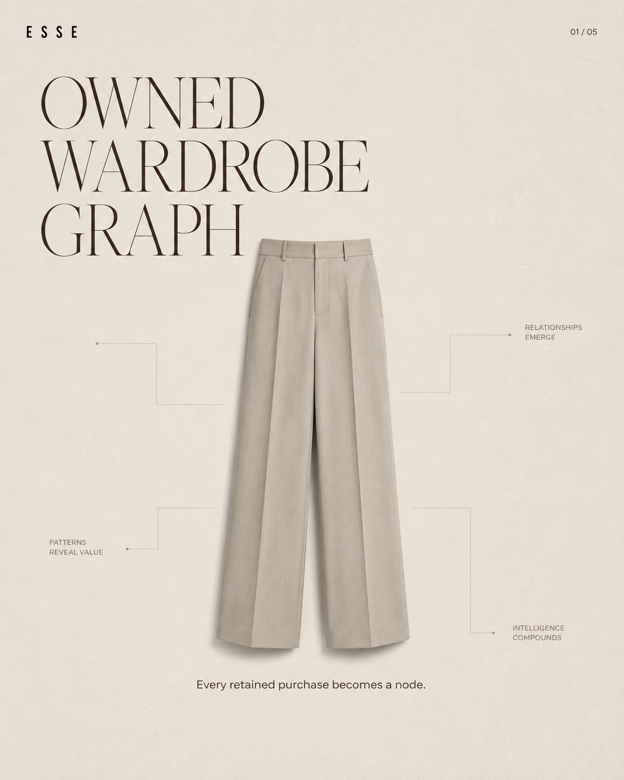
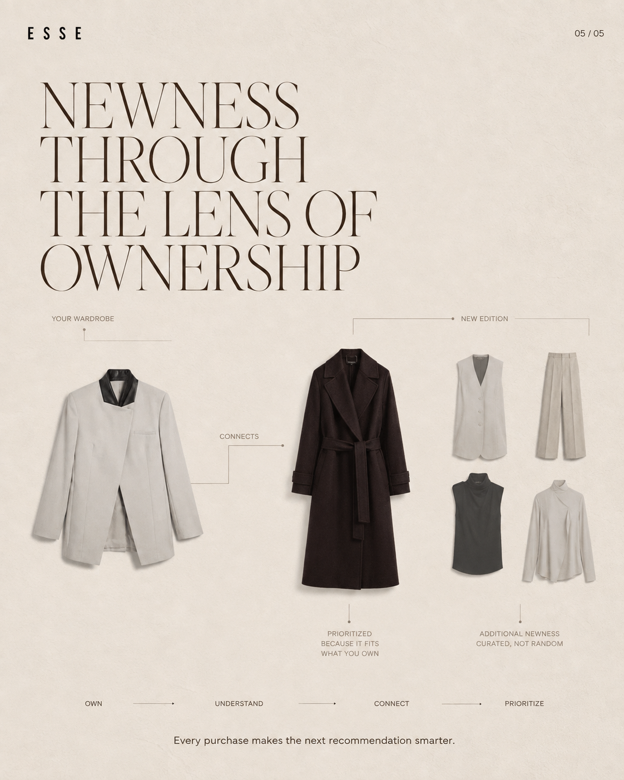
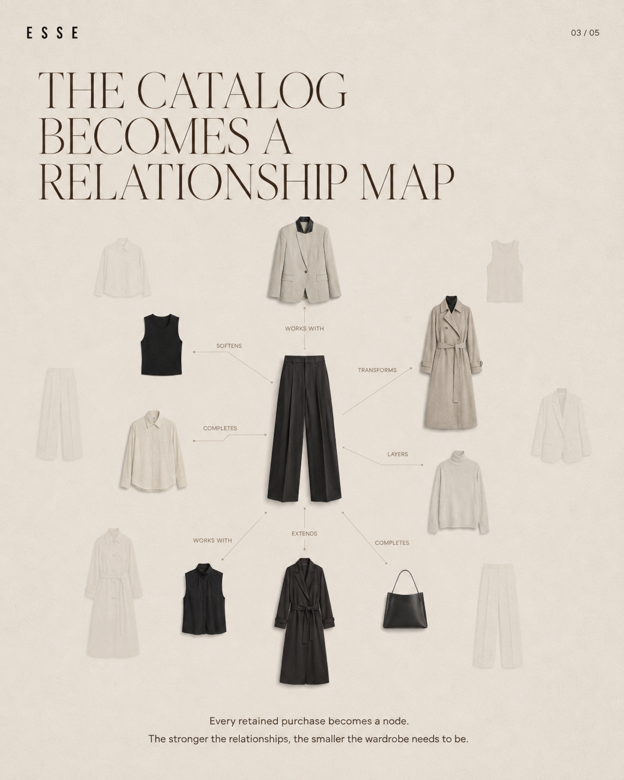
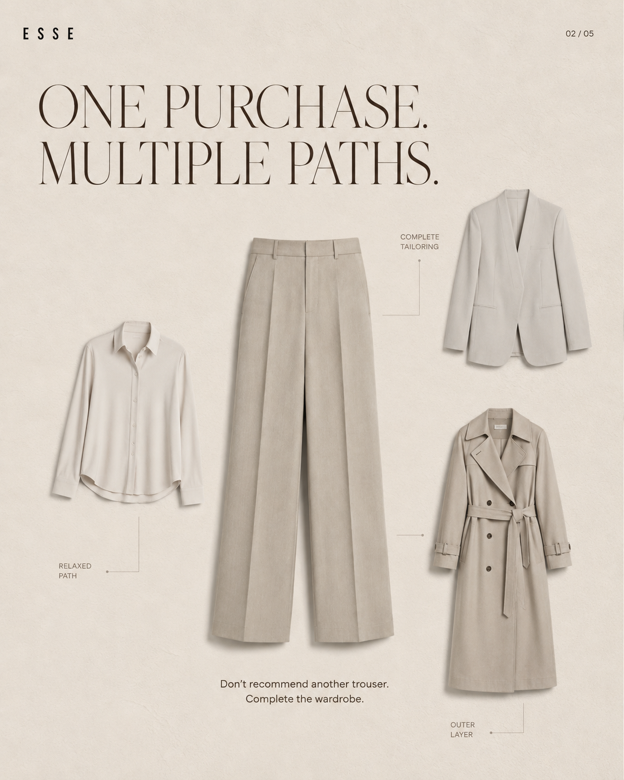
Every retained purchase should become a node in the customer's profile. The catalog relationship map then identifies what can complete, soften, layer, transform, or extend that garment.
Example: If a customer owns the Issia Trouser, the system should not merely recommend "more trousers." It should identify the Alessio Blazer as the complete-tailoring path, a refined shirt or knit as the relaxed path, and the Taro Trench as the outer-layer path. When a new Edition launches, compatible pieces should be ranked above unrelated newness.
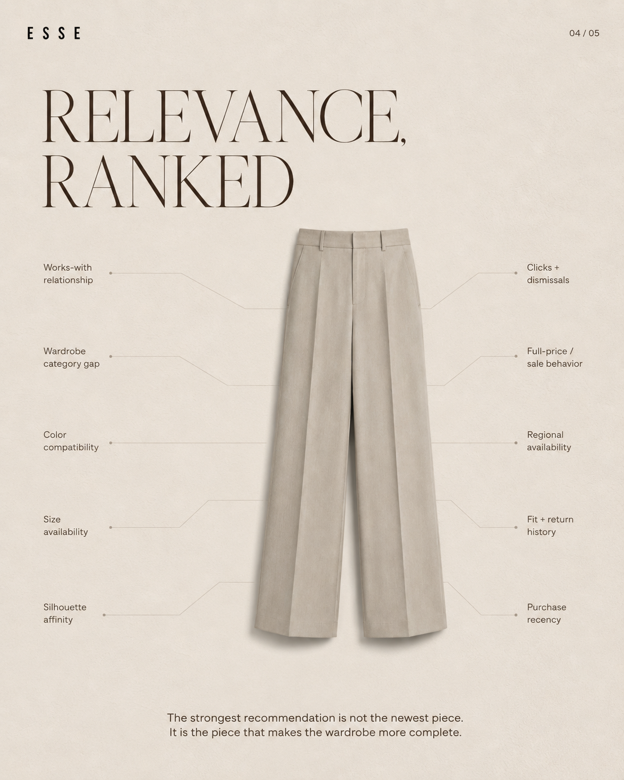
The recommendation score can combine:
- direct works_with relationship;
- category gap in the owned wardrobe;
- color compatibility;
- size availability;
- customer category and silhouette affinity;
- previous clicks and dismissals;
- full-price versus sale behavior;
- regional availability;
- return history by fit profile;
- recency since purchase and post-purchase engagement.
Strategy 2 - Style, Size, and Occasion Expansion
Strategy Overview
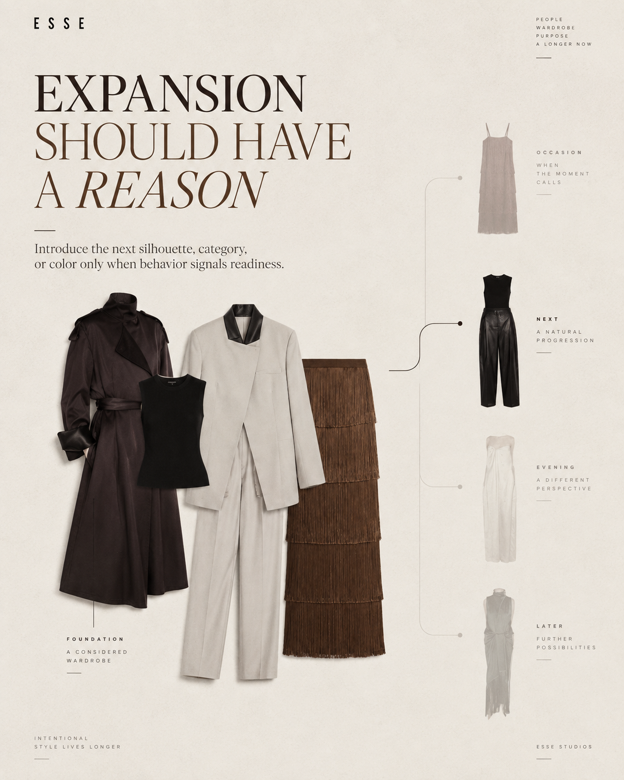
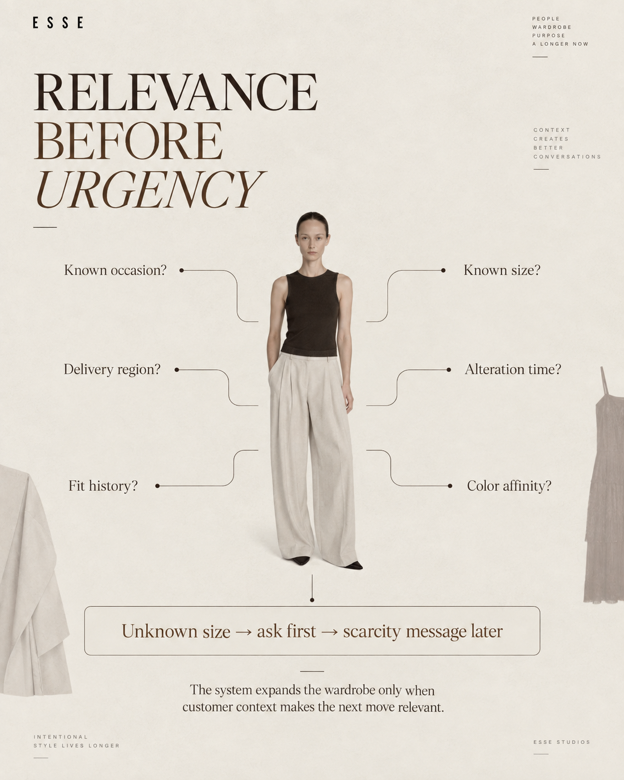
The system should introduce a new silhouette or category only when there is a reason.
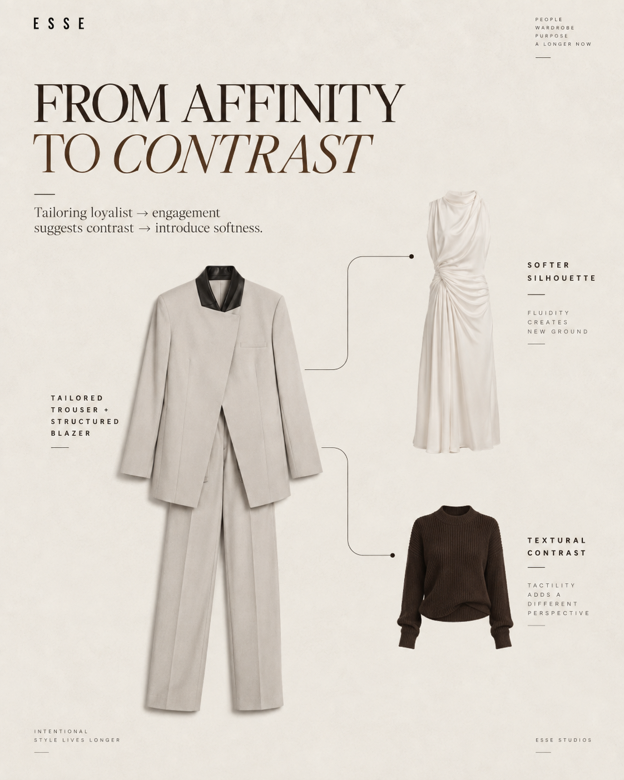
- A tailoring loyalist can be shown a softer dress or knit when her engagement suggests a desire for contrast.
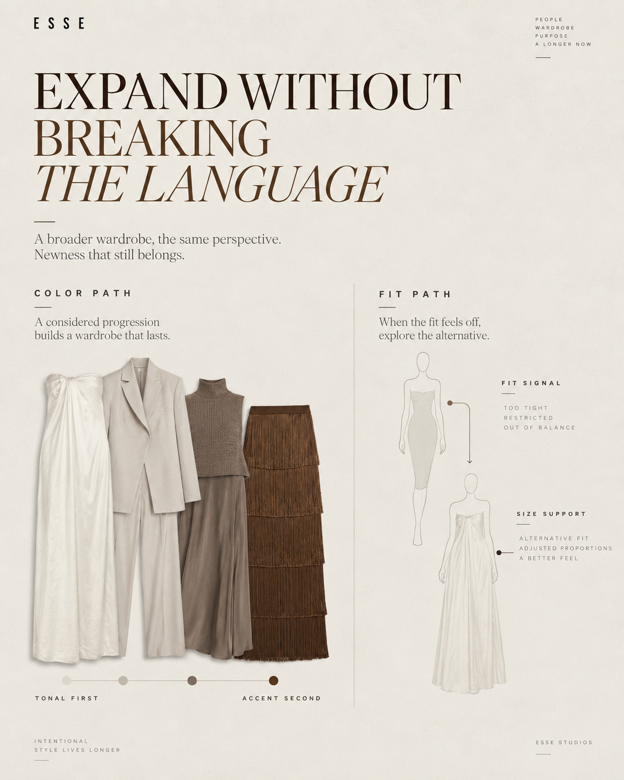
- A customer who repeatedly buys one neutral color can receive a tonal expansion first, then a considered accent color.
- A customer who returned a fitted silhouette should receive a different fit profile or proactive sizing support.
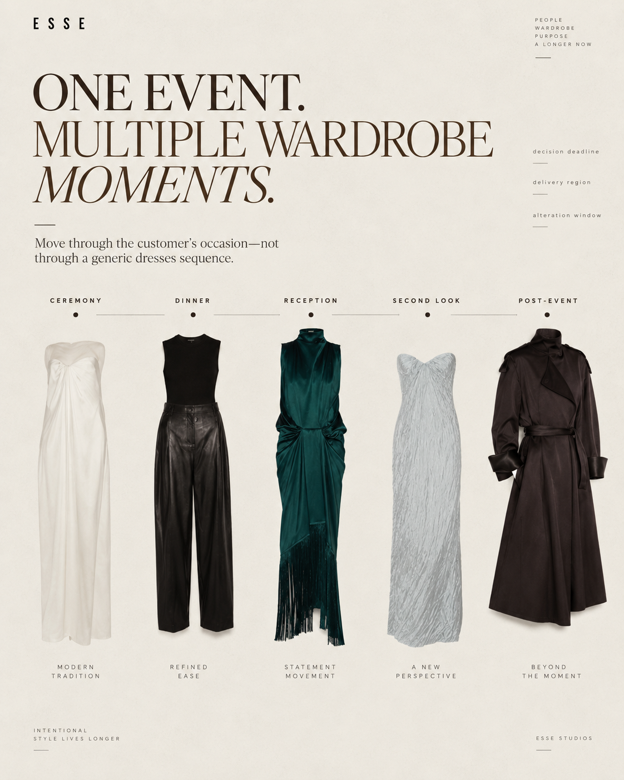
- A modern-ceremony lead should move through ceremony, dinner, reception, second-look, and post-event wear rather than a general dresses sequence.
- A customer with an upcoming event should receive content aligned to the decision deadline, delivery region, and alteration window.
- A customer without a known size should be asked before receiving size-scarcity messages.
Strategy 3 - Private-Client Progression Architecture
Strategy Overview
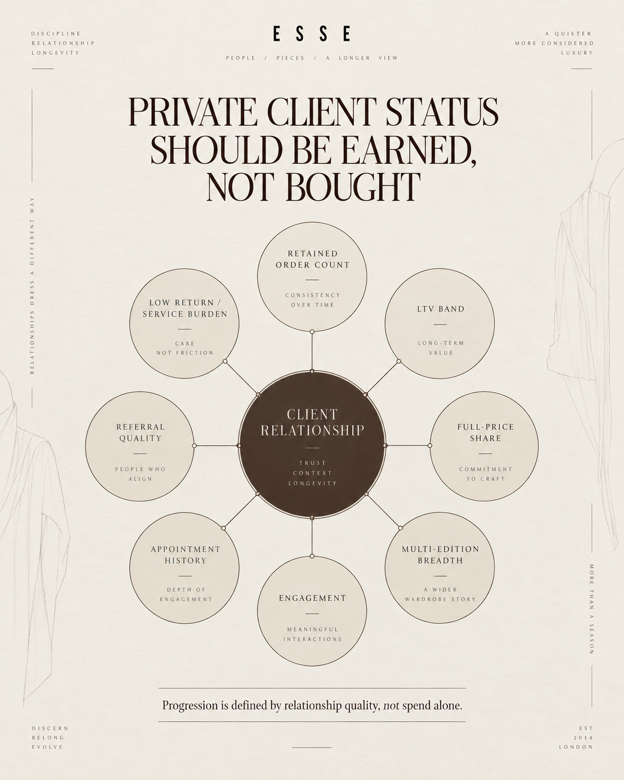
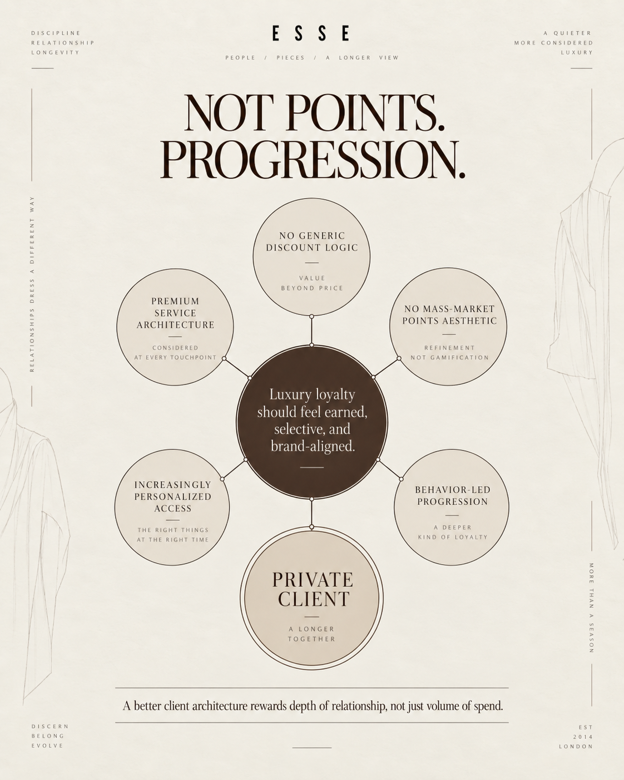
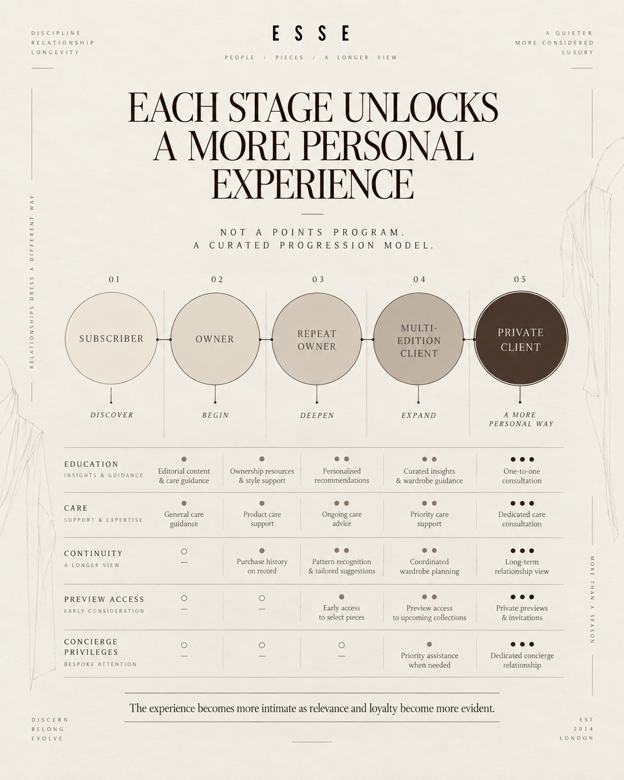
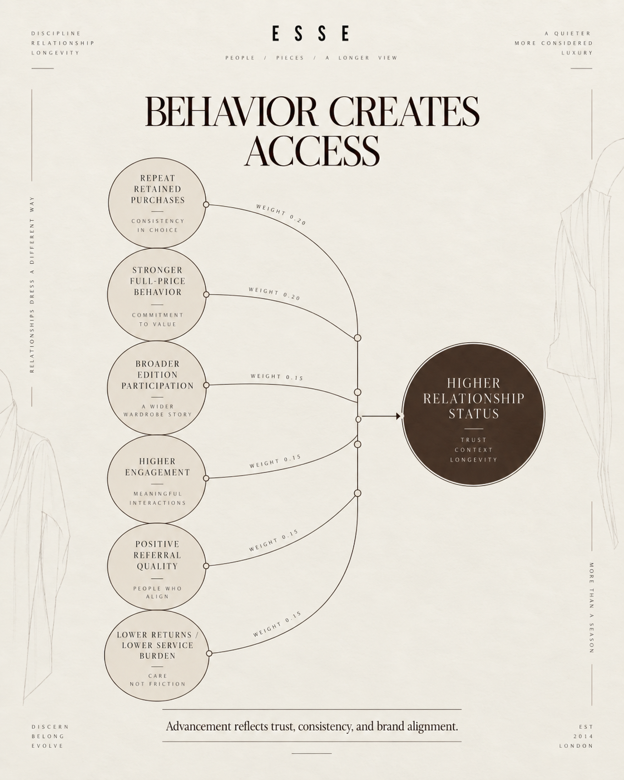
Private-client status should be earned through a combination of behavior, not only spend. A practical score might combine retained order count, LTV band, full-price share, multi-Edition breadth, engagement, appointment history, referral quality, and low return/service burden.
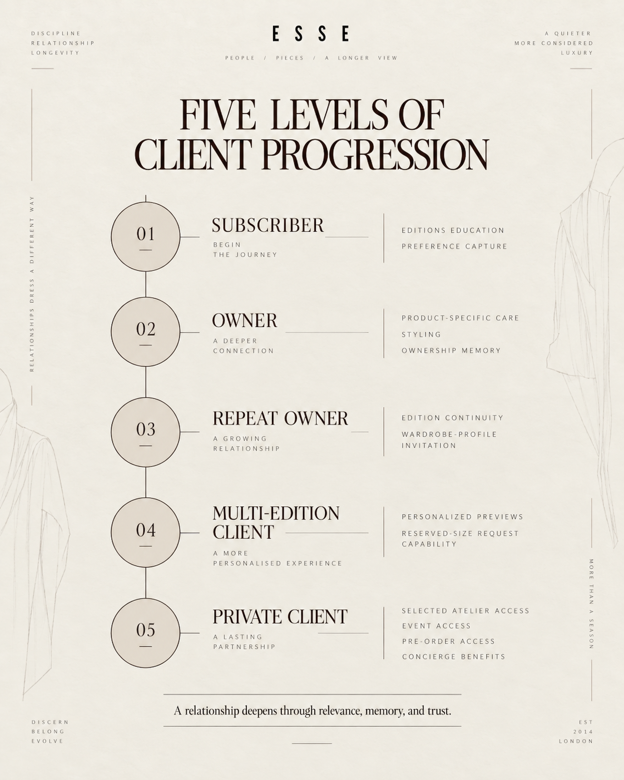
The progression could be:
- Subscriber: receives Editions education and preference capture.
- Owner: receives product-specific care, styling, and ownership memory.
- Repeat owner: receives Edition continuity and wardrobe-profile invitation.
- Multi-Edition client: receives personalized previews and reserved-size request capability.
- Private client: receives selected Atelier, event, pre-order, and concierge benefits.
This avoids a generic points program that may feel disconnected from the brand's positioning.
Strategy 4 - Cross-Channel Retargeting
Strategy Overview
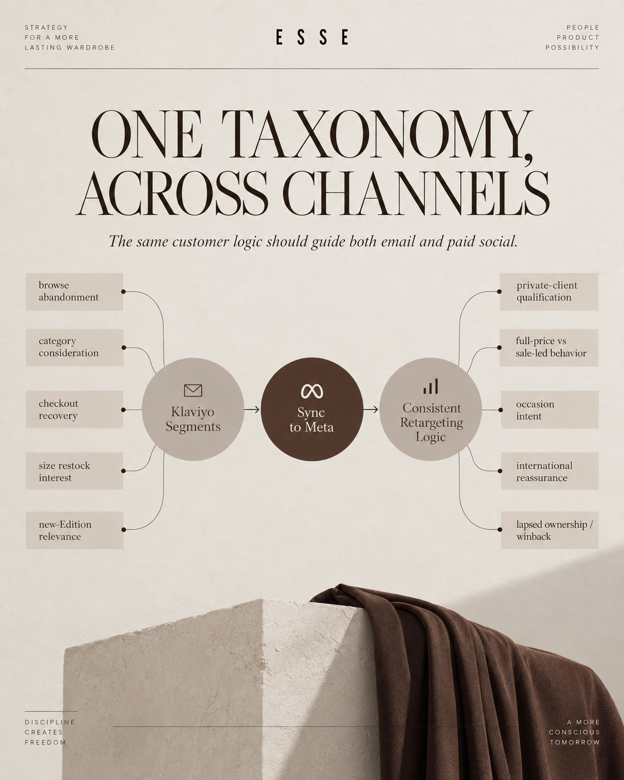
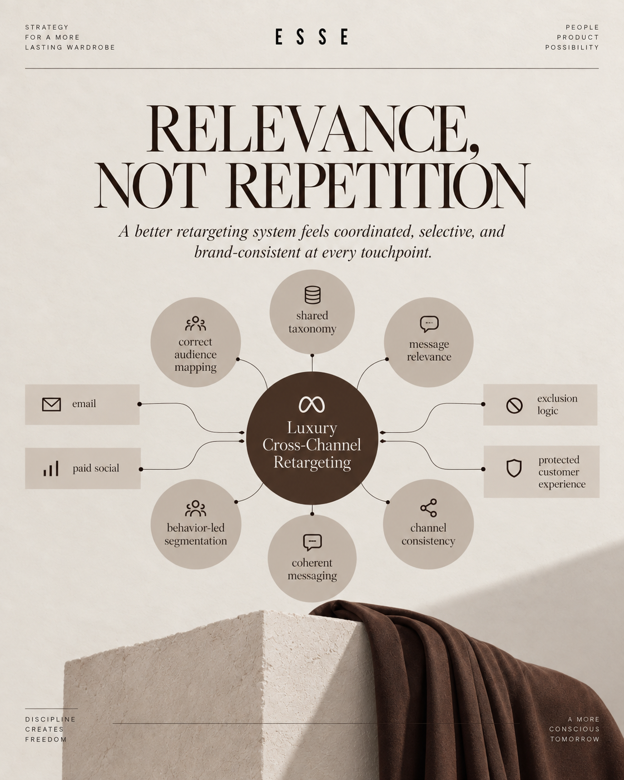
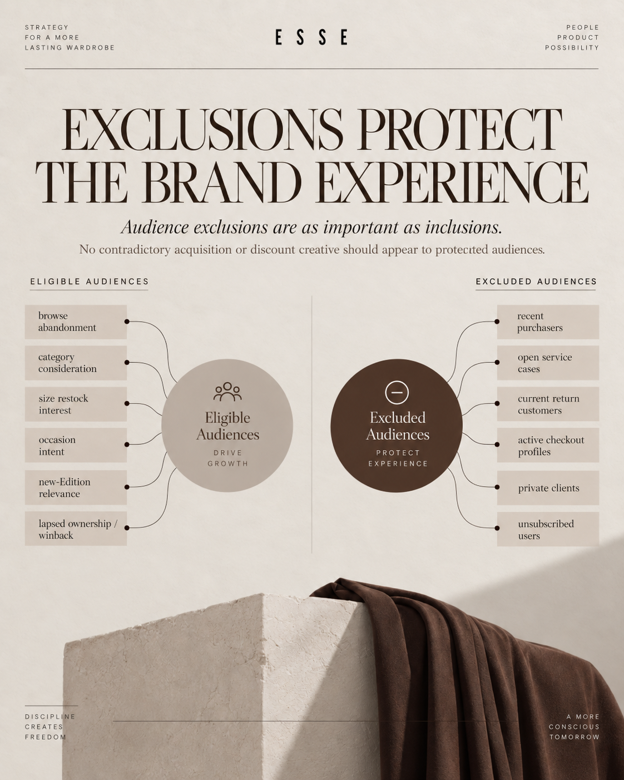
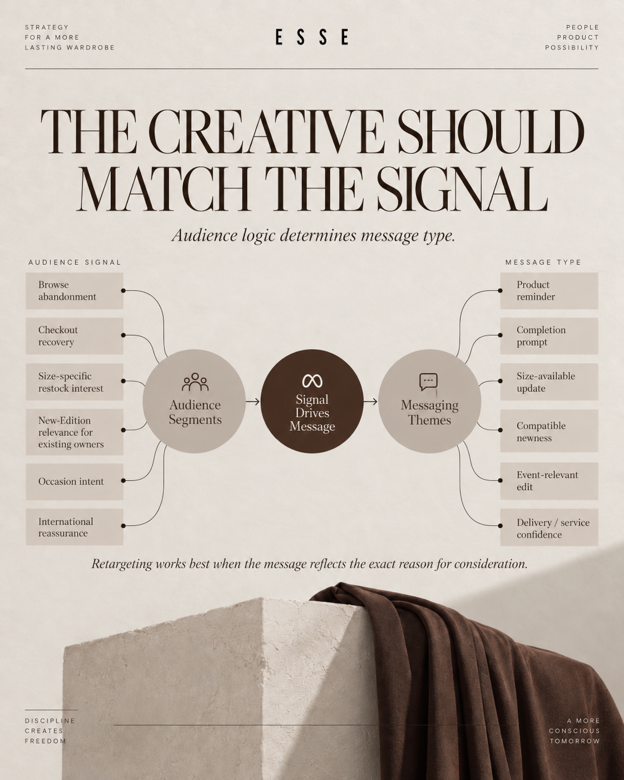
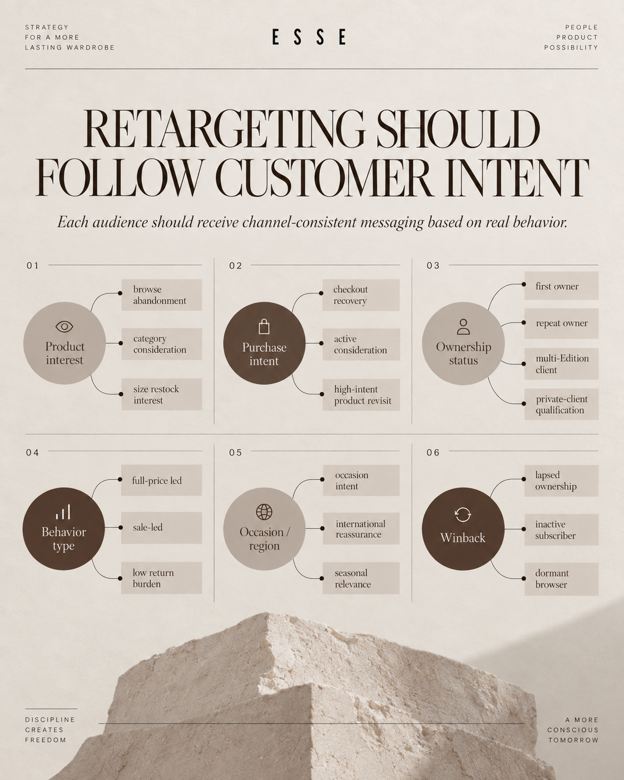
Klaviyo segments should sync to Meta with the same taxonomy used in email:
- product browse abandonment;
- category-specific consideration;
- checkout recovery;
- size-specific restock interest;
- new-Edition relevance for existing owners;
- private-client qualification;
- full-price versus sale-led behavior;
- occasion intent;
- international reassurance;
- lapsed ownership and winback.
Audience exclusions are as important as inclusions. Recent purchasers, open service cases, current return customers, active checkout profiles, private clients, and unsubscribed users should not be shown contradictory acquisition or discount creative.
Strategy 5 - Geographic Confidence Logic
Strategy Overview
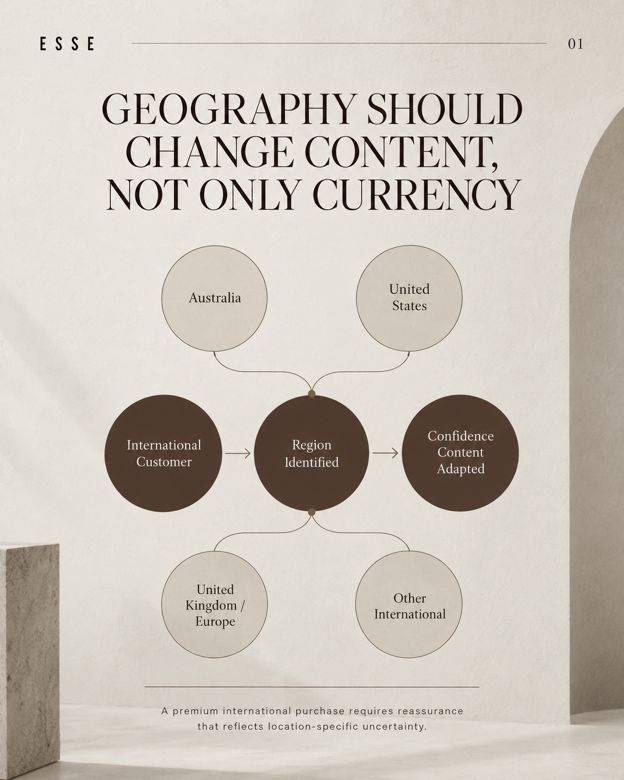
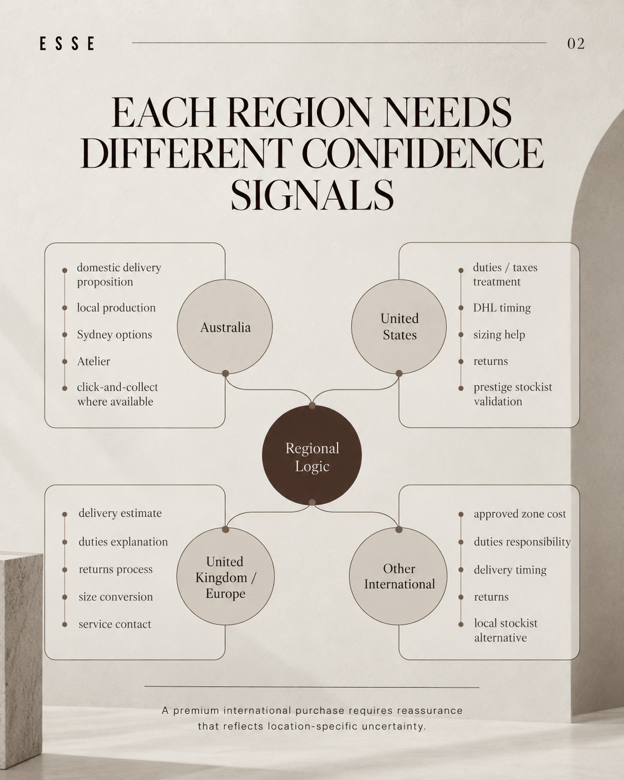
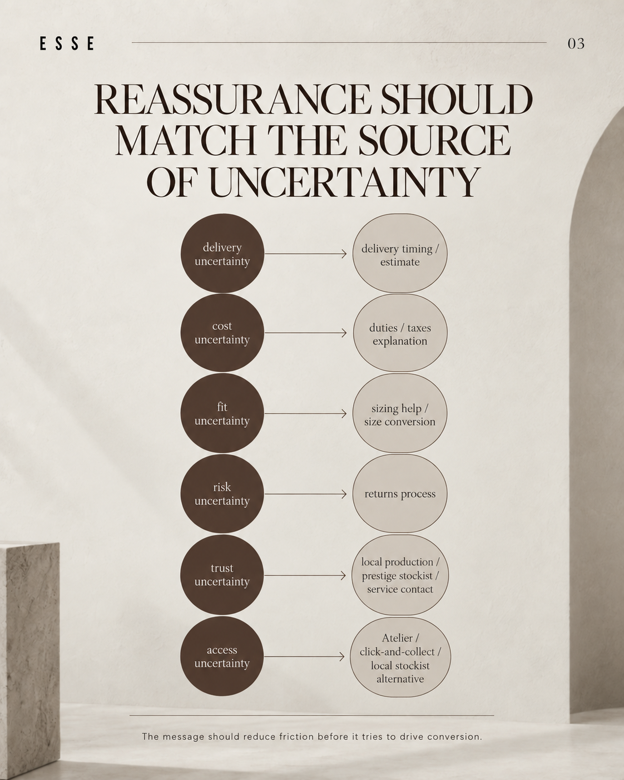
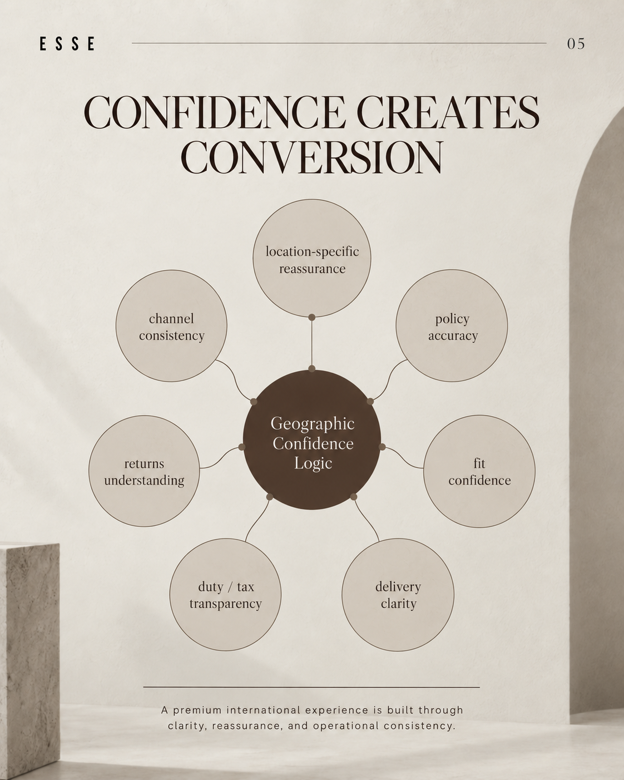
A premium international purchase contains more uncertainty than a domestic one. Geography should change content, not only currency.
Region | Confidence Content |
Australia | Free or current domestic delivery proposition, local production, Sydney options, Atelier, and click-and-collect where available. |
United States | Current duties/taxes treatment, DHL timing, sizing help, returns, and prestige stockist validation. |
United Kingdom / Europe | Delivery estimate, duties explanation, returns process, size conversion, and service contact. |
Other international | Approved zone cost, duties responsibility, timing, returns, and whether local stockists may be an alternative. |
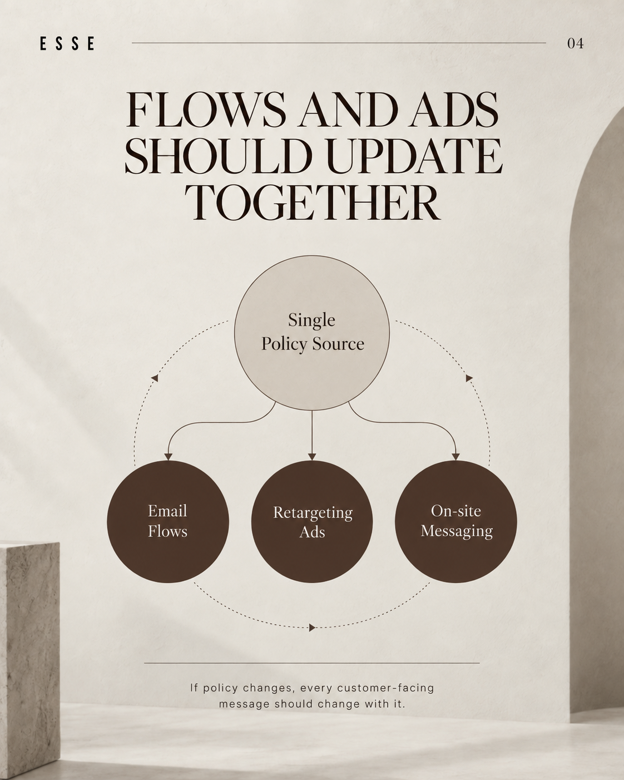
All policy content must come from one maintained source. If site policy changes, flows and ads should update together.
Strategy 6 - Scarcity, Waitlist, and Alternative Logic
Strategy Overview
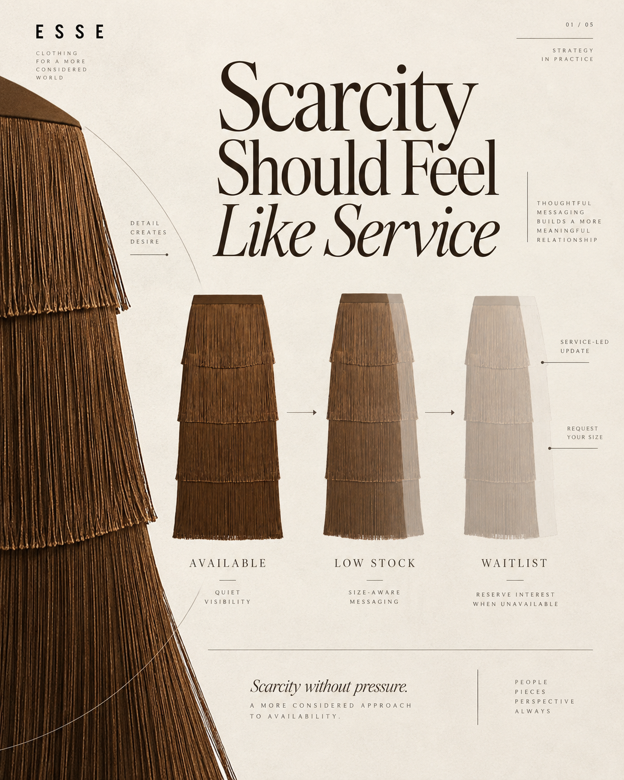
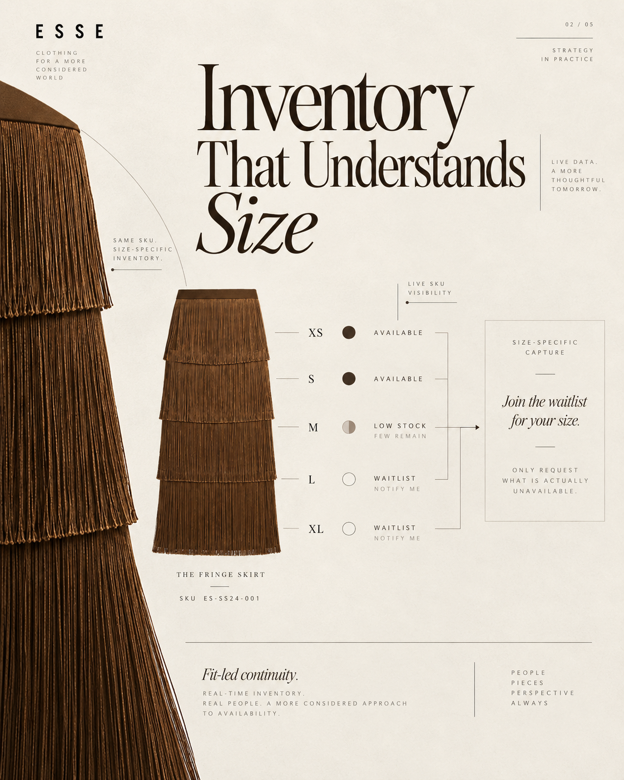
Low inventory should become service, not manufactured pressure.
- Use live SKU-and-size inventory, not hard-coded "selling fast" copy.
- Allow size-specific waitlist capture directly on PDPs and in emails.
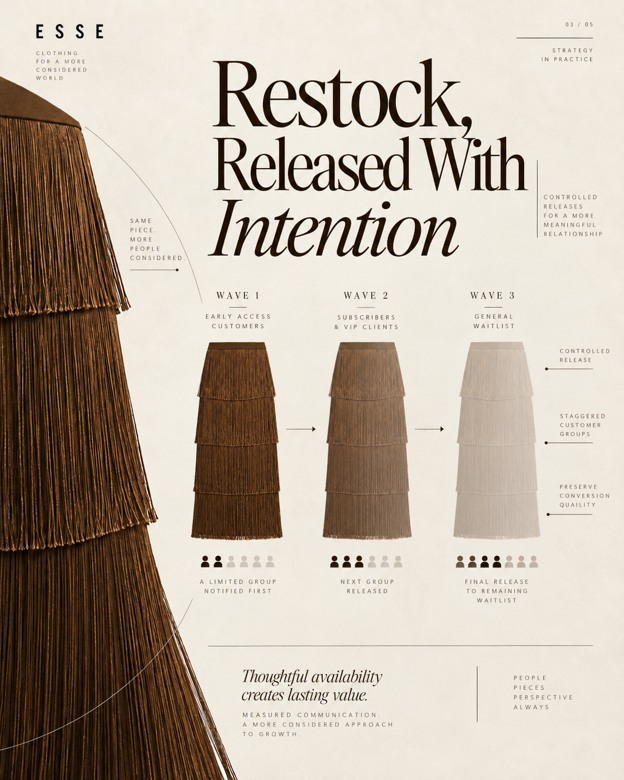
- Batch back-in-stock alerts to avoid disappointing the whole list.
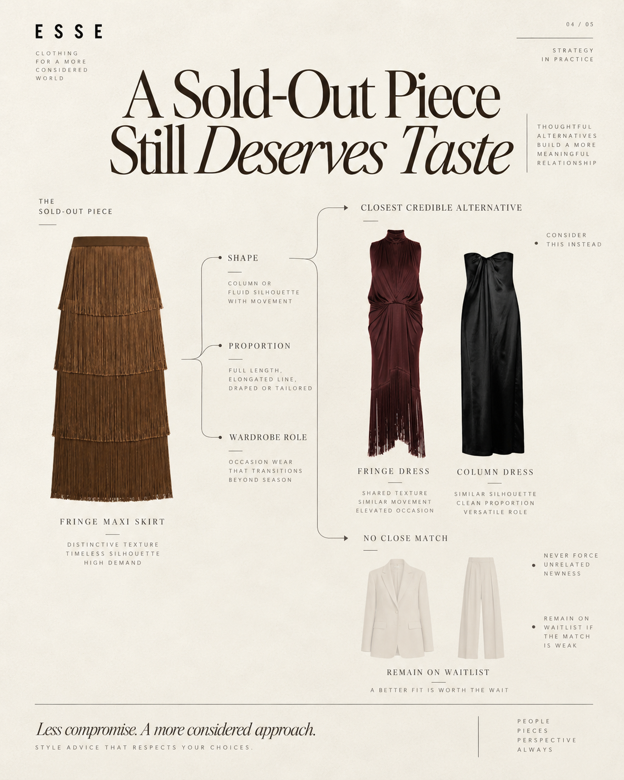
- If the item sells out, offer the closest alternative based on silhouette and wardrobe role.
- If no credible alternative exists, keep the customer on the waitlist rather than forcing an unrelated product.
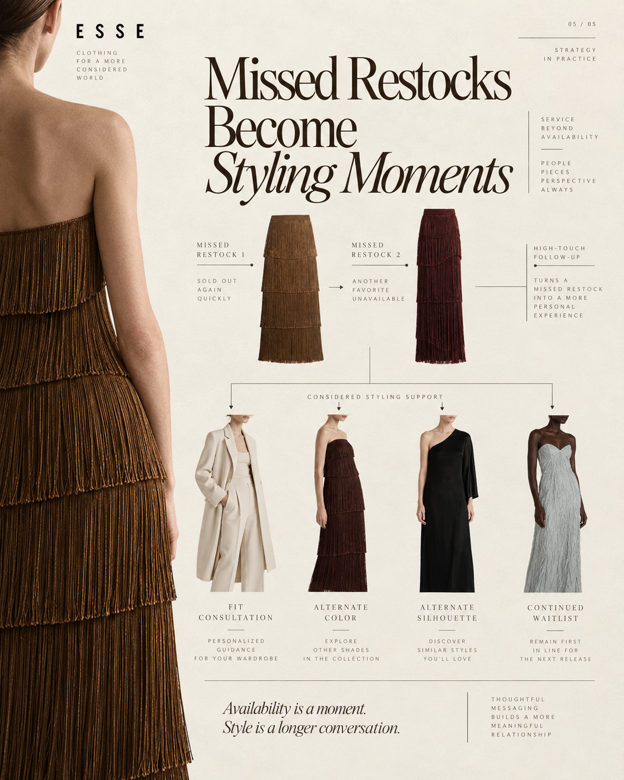
- After two missed restocks, invite fit or styling help and ask whether another color or silhouette is acceptable.
Strategy 7 - Full-Price Versus Sale-Led Treatment
Strategy Overview
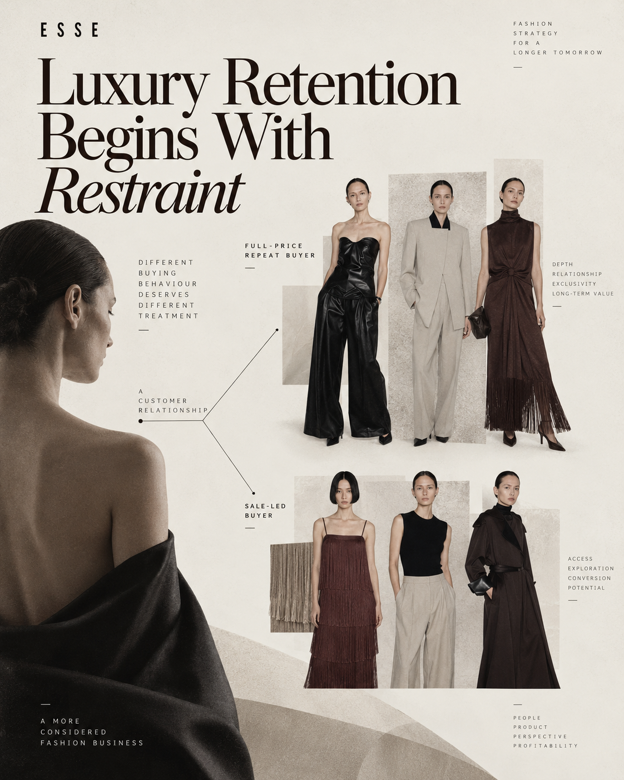
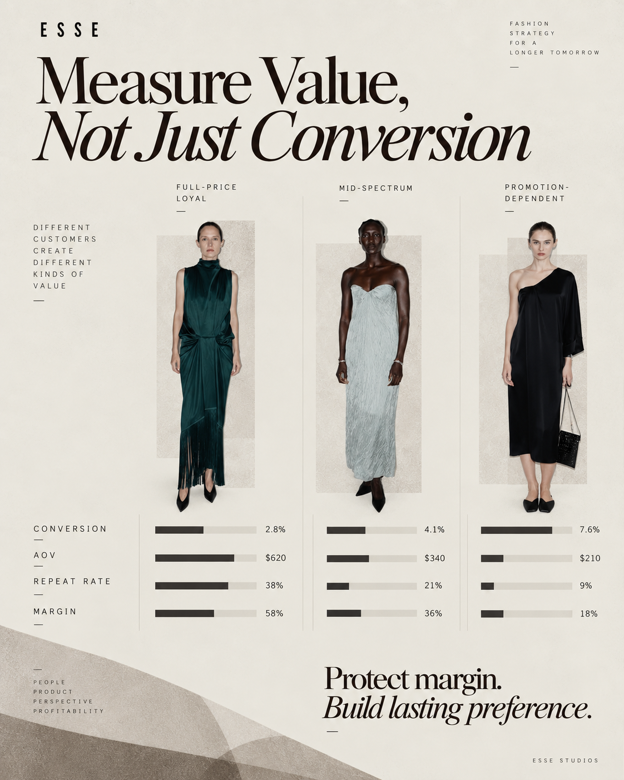
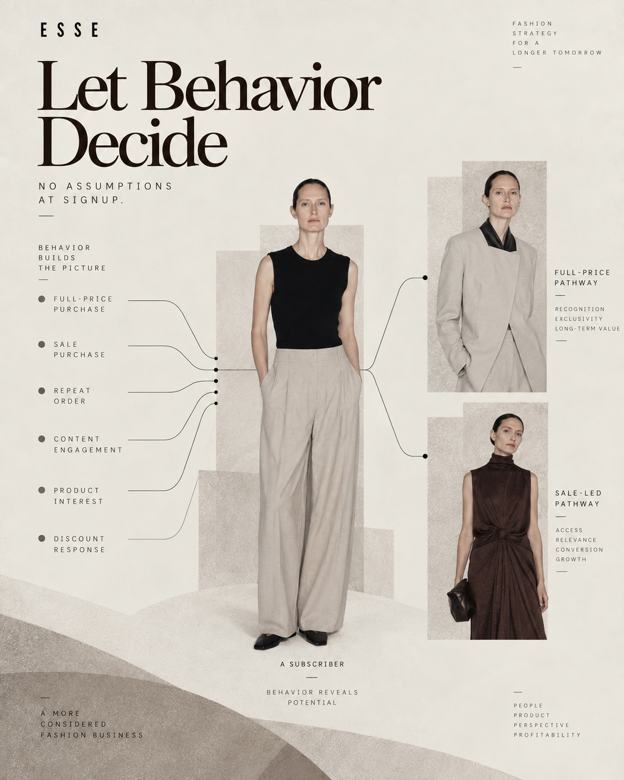
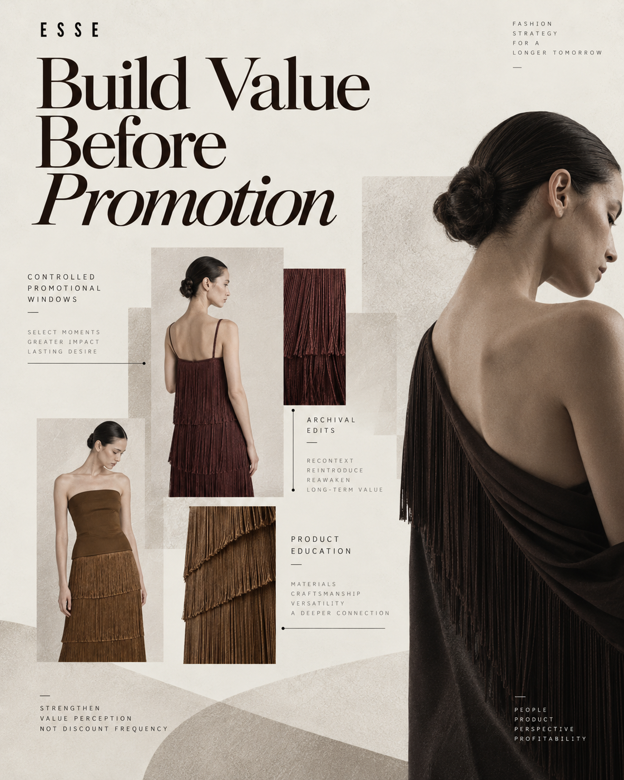
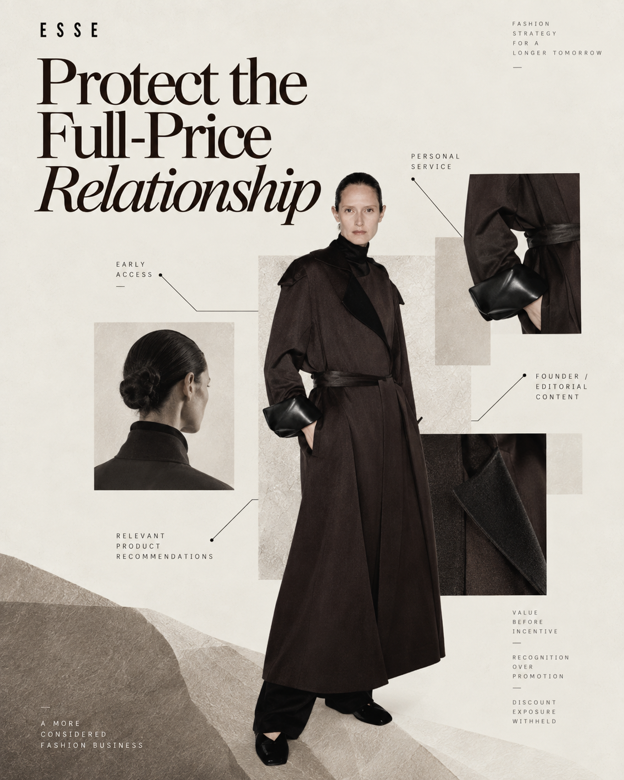
Luxury retention improves when full-price buyers are protected from unnecessary discount exposure.
- Full-price repeat buyers receive access, service, founder/editorial content, and relevant product recommendations.
- Sale-led buyers receive controlled promotional windows, archival edits, and product education designed to build value perception.
- New subscribers are not automatically assigned to either group; behavior over time determines treatment.
- Campaign reporting should compare conversion, AOV, repeat rate, and margin by discount-dependency band.
Strategy 8 - Review-to-Referral and Service Feedback Loop
Strategy Overview
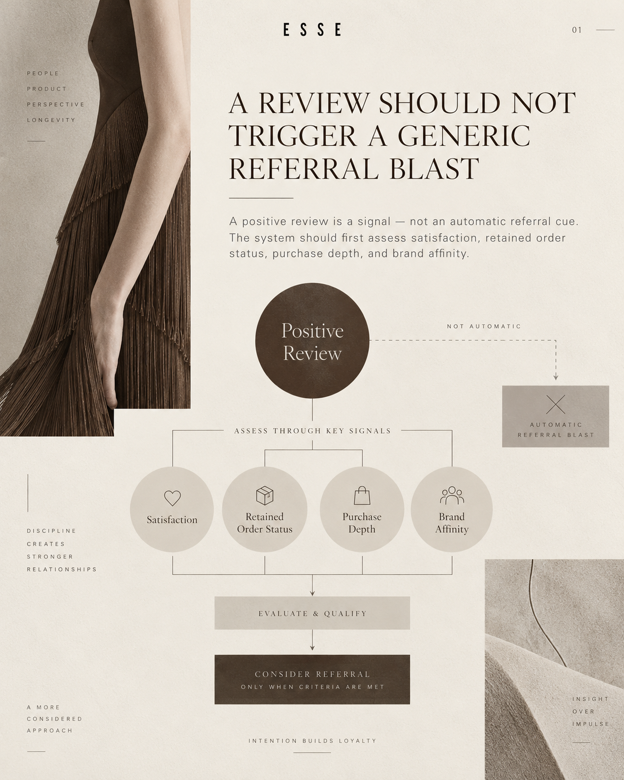
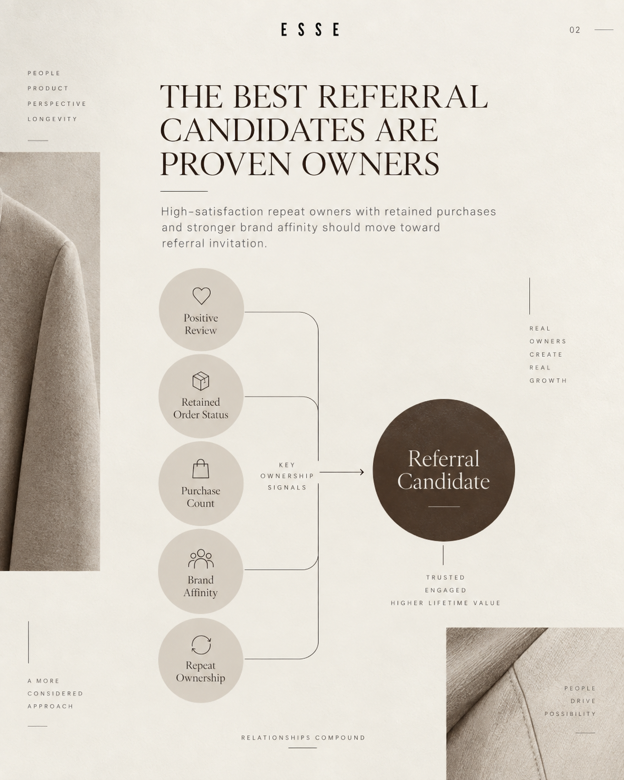
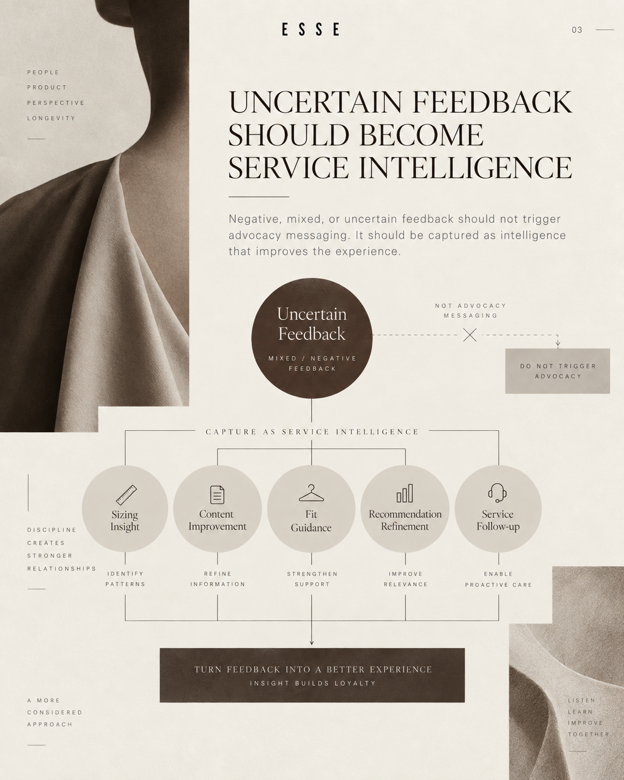
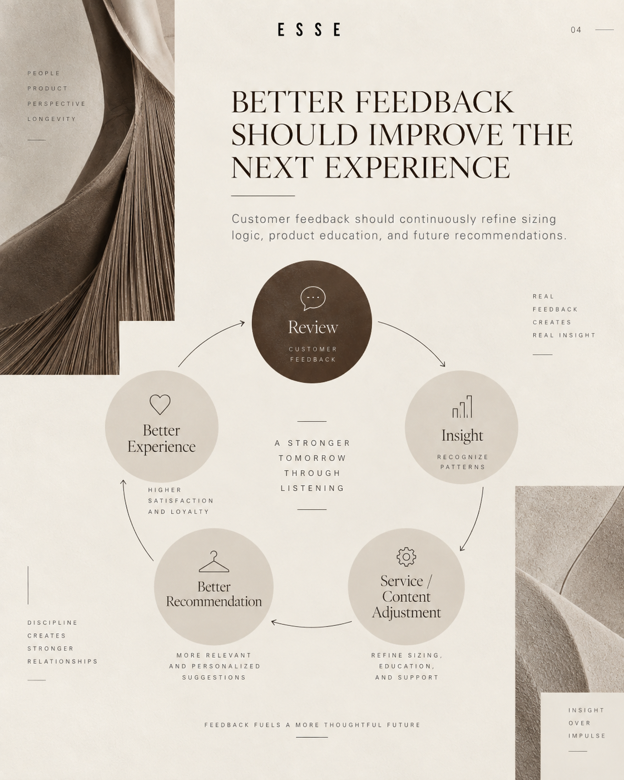
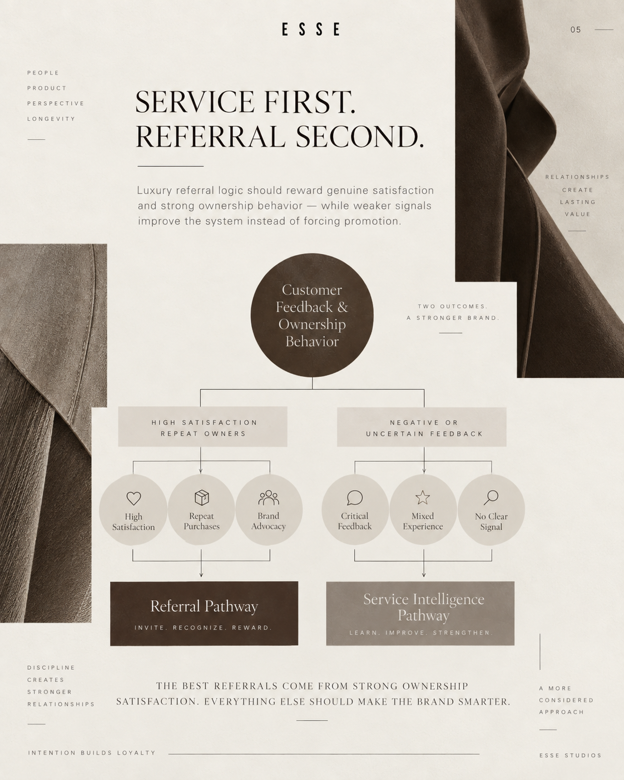
A positive product review should not immediately trigger a generic referral blast. The system should assess satisfaction, retained order status, purchase count, and brand affinity. High-satisfaction repeat owners are the best referral candidates. Negative or uncertain feedback should become service intelligence that improves sizing, content, and future recommendations.
Campaign Strategy
ESSE can maintain a meaningful 1-3 campaign-per-week rhythm without sending every campaign to the entire list. The calendar should balance product, perspective, wardrobe education, service, and selective urgency.
Campaigns should support lifecycle behavior rather than interrupt it. The campaign calendar is a planning layer; each send still requires audience criteria, exclusions, content relevance, and frequency control.
Campaign Type | Audience | Purpose |
Founder / perspective note | Editorially engaged, new subscribers, brand-story readers | Deepen the philosophy of intentional luxury and create affinity without a product-grid feel. |
Edition preview | Category-relevant engaged subscribers; private clients receive first wave | Build anticipation and explain continuity with prior Editions. |
Product spotlight | Exact product/category affinity, excluding recent purchasers | Resolve fit, construction, styling, and investment objections around one garment. |
Wardrobe-building email | Existing owners segmented by owned SKU | Show the next addition that expands use of what the customer already owns. |
Made in Sydney / craft story | Sustainability and product-detail engagers | Turn local making, specialty makers, and fabrication into trust and value. |
Modern Ceremony edit | Occasion and bridal-intent segment | Support ceremony, dinner, reception, second look, and wear-after-event use cases. |
Restock / low stock | Exact SKU/size interest only | Convert genuine scarcity without broadcasting pressure to irrelevant customers. |
Private-client campaign | Qualified repeat/VIP customers | Early access, reserved size, appointment, event, or stylist/founder edit. |
Referral campaign | Satisfied repeat owners and advocates | Acquire high-fit customers through trusted introductions. |
Controlled promotion | Discount-sensitive and eligible non-buyers; full-price/VIP exclusions | Convert price-led demand without training the entire database to wait for sale. |
Care / ownership content | Recent owners by product type | Increase satisfaction, garment longevity, and brand credibility. |
Winback campaign | Lapsed owners by prior SKU/category | Reconnect through owned-wardrobe relevance. |
Example Monthly Campaign Calendar
Week | Campaign 1 | Campaign 2 | Campaign 3 |
Week 1 | Founder note: “Why every Edition begins with what came before” – broad engaged editorial segment | Tailoring spotlight: Alessio and Issia – tailoring affinity, no recent buyers | Product-specific care note – recent tailoring owners only |
Week 2 | New Edition preview – private clients first, then category-relevant engaged audiences | Made in Sydney: inside one garment’s construction – craft engagers | Size-specific restock alert – waitlist only, sent in controlled waves |
Week 3 | The Modern Ceremony Edit – occasion segment | “Three ways to build on your Issia Trouser” – Issia owners | International confidence note – high-intent US/UK/EU browsers |
Week 4 | Wardrobe Notes: one foundation, three contexts – broad engaged list | Private-client appointment or reserved-size invitation – qualified segment | Lapsed-owner re-entry – prior SKU/category path |
Campaign Suppression Rules
- Someone in checkout abandonment should not receive a general promotion at the same time.
- Someone with an open return, exchange, delivery, or service issue should receive support, not selling.
- A recent purchaser should not receive first-purchase messaging or a discount on the item just purchased.
- A customer who owns a product should not receive an acquisition campaign for the same SKU unless it is explicitly a gifting or alternate-color context.
- A full-price buyer should not be overexposed to discount campaigns.
- A discount-sensitive buyer should receive controlled promotional logic, not every private-client message.
- A VIP should not receive the same acquisition creative as a new subscriber.
- A size-specific waitlist customer should receive inventory information before a broad category campaign.
- A lapsed owner should receive ownership-aware re-entry, not the same message as a hot browser.
- A subscriber who selected lower frequency should be placed in a reduced editorial cadence.
- A customer in the first 10-14 days after delivery should primarily receive ownership and service content.
- Meta exclusions should mirror email suppressions so the customer does not see contradictory paid creative.
Content Mix
A balanced monthly mix could target approximately:
- 25-30% product and Edition storytelling;
- 20-25% wardrobe-building and styling;
- 15-20% founder, making, and local craft;
- 10-15% service, fit, shipping, and confidence;
- 10-15% ownership, care, review, and referral;
- 5-10% selective urgency, restock, or promotion.
The percentages are planning guides, not fixed quotas. New-Edition months will naturally carry more launch content; quieter months can deepen wardrobe and ownership storytelling.
Meta-Based Newsletter Subscription Growth Strategy
Paid acquisition should not force every cold prospect directly into a premium product decision. A softer first conversion can capture intent, preference, and permission, then let Klaviyo complete the education.
Campaign Goal
Use low-budget Meta campaigns to turn qualified cold and warm fashion audiences into owned email subscribers by offering a brand-specific wardrobe tool delivered by email.
Primary paid lead offer
Find Your ESSE Starting Point
Choose the wardrobe role you need most. Receive a considered edit for tailoring, outerwear, wardrobe foundations, or modern ceremony – plus private access to new Editions and relevant restocks.
A discount can be tested later against a non-discount lead magnet, but the strategic default should protect ESSE’s price integrity. The lead offer must be useful even when the visitor is not ready to buy that day.
Campaign Element | ESSE Strategy |
Audience | Warm site and social engagers; editorial readers; lookalikes of retained full-price and repeat customers where consent and platform rules allow; cold audiences aligned to premium contemporary fashion, tailoring, intentional wardrobes, and modern occasion dressing. |
Offer | Personalized “Find Your ESSE Starting Point” edit or downloadable Wardrobe Notes, not a generic newsletter invitation. |
Landing page | Explain Editions, present four wardrobe entry paths, ask concise preference questions, and deliver one relevant category/product recommendation subject to live stock. |
Form fields | Email first; optional SMS with separate consent; region; likely size; wardrobe focus; optional occasion month; fit preference. Keep required fields minimal. |
Follow-up flow | Route into the Welcome Flow with category, size, region, and source properties already populated. High-intent product clicks move into browse logic. |
Retargeting layer | Exclude subscribers from lead ads; move them into category-specific content, exact-product consideration, or new-Edition audiences. |
Measurement | Cost per qualified subscriber, completed preference rate, first-product view, welcome click rate, first purchase within 30/60/90 days, retained-order rate, and downstream LTV – not cost per lead alone. |
Why a subscriber conversion matters
A cold visitor may appreciate the brand but need more time to understand fit, material, styling, delivery, and the Editions concept. Direct-to-purchase ads repeatedly charge ESSE for every additional impression. An email subscriber gives the brand permission to continue the relationship through owned channels, gather preference data, and coordinate future paid touchpoints more efficiently.
The subscriber is not automatically valuable. Quality depends on whether the lead magnet attracts people with genuine product and wardrobe intent. A broad giveaway or deep discount may produce cheap leads but weak full-price conversion. The landing page, questions, creative, and optimization event should therefore favor relevance over raw form volume.
Ad Angle Examples
Angle | Example Creative Message |
Editions philosophy | “A wardrobe is built, not replaced. Discover where your ESSE wardrobe begins.” |
Tailoring | “One tailored foundation. Multiple ways to wear it. Receive the ESSE Tailoring Notes.” |
Wardrobe utility | “Five considered foundations. A personal edit built around how you dress.” |
Modern ceremony | “For the ceremony, dinner, second look – and the wardrobe after. Receive the Modern Ceremony Edit.” |
Local making | “Designed and largely made in Sydney. Explore the pieces and process behind an intentional wardrobe.” |
Private access | “New Editions, relevant restocks, and wardrobe notes – selected around what you actually return to.” |
Budget and Optimization Discipline
Begin with a controlled test across warm engagement and one or two cold concepts. Optimize first for completed lead plus preference, then evaluate quality through 30- and 60-day behavior. Pause creatives that produce low-cost leads but no product engagement. Scale only when cohorts show healthy click, first-purchase, retained-order, and unsubscribed-profile economics.
Meta Ads Retargeting Strategy
Email, SMS, and paid media should use the same customer state. The customer should experience one coherent wardrobe journey, not three disconnected marketing calendars.
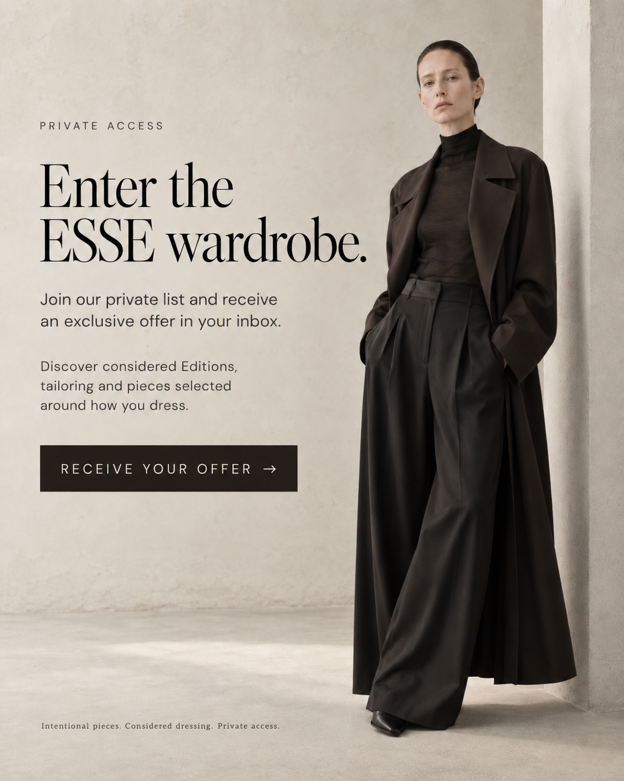
Klaviyo Segment | Meta Retargeting Angle |
Email subscriber, no purchase | Editions education, chosen wardrobe path, and the strongest category/product clicked in welcome. |
Taro Trench browser | Product-specific fit, layering, construction, and availability creative. |
Alessio / Issia tailoring browser | Coordinated tailoring, fit confidence, and complete-the-line creative. |
Mila / occasion browser | Event use, bodice/fit confidence, modern ceremony, and wear-after-the-event positioning. |
Cart abandoner | Saved edit with exact product, size where permitted, and styling value; exclude if checkout begins. |
Checkout abandoner | Confidence-led recovery: fit, delivery, duties, returns, or human support. Suppress generic promotions. |
Size-specific waitlist | Back-in-stock or alternative-silhouette creative only when live availability supports it. |
First-time owner | Care, styling, and owned-product value; generally exclude from immediate acquisition ads. |
Past buyer ready for next addition | New-Edition pieces compatible with owned SKU/category. |
Repeat buyer not yet private client | Wardrobe profile, early-access, and direct-service value. |
Private client / VIP | Relevant previews, events, appointments, and reserved access; no public acquisition discount creative. |
International high intent | Region-specific delivery, duties, sizing, and returns reassurance using approved current policy. |
Lapsed owner | Owned-product-based re-entry and latest Edition compatibility. |
Discount-sensitive buyer | Controlled sale/archive creative with frequency and margin guardrails. |
SMS subscriber | Time-sensitive product access only; do not mirror every SMS as an ad. |
Audience Windows and Creative Rotation
- 1-3 days after high-intent browse: exact product and fit.
- 4-14 days: construction, styling, social/editorial proof, and alternative view.
- 15-30 days: category education or saved edit rather than repeated product stalking.
- 30-90 days for non-buyers: Editions, founder, making, and category entry-point content.
- Post-purchase: exclude from product acquisition; introduce ownership and next-addition only after the appropriate settling period.
- Lapsed owners: use longer windows based on actual purchase cadence, not a universal 30-day retargeting pool.
Cross-Channel Rules
- Klaviyo is the source of lifecycle state; Meta is an activation channel.
- Purchases, returns, private-client status, and service cases should update audience exclusions quickly.
- Creative should match the same product and objection addressed in email.
- Frequency caps should be stricter for high-consideration products to avoid cheapening the experience.
- Use retained-order and lifetime-value cohorts for optimization where technically and legally appropriate, not only immediate purchase value.
- Report incremental performance by audience and holdout where possible; platform-reported ROAS alone can overstate impact.12. Referral Program Strategy
Referral should be a trusted introduction between people with similar taste, activated after confidence is proven and designed to protect full-price positioning.
Offer Structure
Person | Example Incentive Model |
Referred friend | Private welcome benefit: complimentary express delivery in Australia, an A$75 credit on a qualifying first full-price order, or an approved region-specific service benefit. |
Referrer | A$100 wardrobe credit after the friend’s retained qualifying order, or a private-client benefit such as styling access or reserved-size priority. |
The exact benefit requires testing and margin review. A shipping, service, or access benefit may feel more aligned than a public percentage discount. Referral codes should have qualifying spend, product, sale, stacking, geographic, expiry, return-window, and fraud controls.
Best Referral Triggers
Trigger | Why It Works |
After second retained purchase | The customer has demonstrated repeat confidence, not only a one-time transaction. |
After positive product review | Satisfaction is explicit and product-specific. |
After multi-Edition ownership | The customer understands the central brand philosophy and can introduce it authentically. |
After private-client qualification | High-fit customers are more likely to refer similarly aligned customers. |
After successful Atelier appointment | A high-service moment creates a natural invitation to share the experience. |
After retained new-Edition purchase | The customer has acted on continuity and is actively engaged. |
After UGC or styling contribution | The customer is already advocating or participating. |
After a referral clears the return window | The reward is tied to a retained, qualifying order. |
Referral Lifecycle
- Identify eligible advocates through satisfaction and retained-order data.
- Invite with a tasteful, non-mass message anchored in shared taste.
- Give the customer a personal referral link or code.
- Deliver the friend’s benefit with a brand introduction and tailored welcome flow.
- Delay the referrer’s reward until the order clears fraud and return controls.
- Update both profiles: referral source, referred category, retained order, and advocate tier.
- Recognize strong advocates with private-client service rather than increasingly aggressive discounts.
Brand-specific referral message
Introduce someone to ESSE.
Share a private invitation with someone whose wardrobe you understand. She will receive a considered welcome benefit for her first full-price addition. Once it becomes part of her wardrobe, your next ESSE addition will be recognised too.
Expected Revenue Impact
The opportunity is a combined lifecycle effect: more qualified subscribers, greater purchase confidence, higher recovery, stronger direct repeat behavior, relevant wardrobe expansion, and more efficient retargeting.
Based on the public-facing opportunities and the hypothetical system outlined above, ESSE Studios could potentially unlock up to 40% additional lifecycle-driven revenue through retention optimization, improved first-purchase conversion, product-specific recovery, ownership-aware repeat purchase, private-client development, referral acquisition, and email/SMS/paid-media alignment.
This is not a guarantee, target commitment, or claim about current performance. It is a directional scenario to frame the size of the opportunity before private data is available. The number should be replaced by a bottom-up forecast after baseline analysis.
Growth Lever | Potential Impact |
Lead capture and welcome | More qualified subscribers, clearer preference data, and stronger first-purchase conversion without default discounting. |
Browse recovery | More high-intent return visits through exact-product, fit, construction, and styling relevance. |
Cart and checkout recovery | Higher conversion through regional reassurance, service, stock, and objection handling. |
Post-purchase stewardship | Higher confidence, lower avoidable dissatisfaction, greater care engagement, and a stronger second-purchase bridge. |
Edition continuity | More repeat revenue by making each launch personally relevant to owned garments. |
Cross-sell / Complete the Edition | Higher AOV and LTV through wardrobe-role recommendations and owned-SKU suppression. |
Private-client progression | Greater direct-channel loyalty, full-price retention, and repeat purchasing through access and service. |
Waitlist and back in stock | Recovered demand from size shortages, restocks, and low-stock interest. |
Referral | Lower-cost, taste-aligned acquisition from satisfied repeat owners. |
Winback | Recovered lapsed owners through wardrobe relevance rather than broad discounting. |
Meta retargeting | Better paid efficiency through lifecycle-matched audiences and exclusions. |
Sunset suppression | Stronger deliverability, cleaner engagement signals, and reduced wasted campaign volume. |
Core KPIs to Track
KPI | Why It Matters |
Email/SMS-attributed revenue share | Measures lifecycle contribution, with attribution settings clearly defined. |
Flow revenue by stage | Shows where automation creates conversion, retention, and reactivation value. |
Campaign revenue by segment | Prevents broad-list averages from hiding audience quality. |
Subscriber-to-first-purchase rate | Measures lead quality and welcome effectiveness at 30, 60, and 90 days. |
First-purchase retained-order rate | Separates gross conversion from orders later returned. |
Browse-to-cart and checkout conversion | Measures confidence and recovery by product/category. |
Repeat purchase rate | Tracks movement from owner to repeat owner. |
Time to second purchase | Measures how efficiently Edition continuity and next-addition logic work. |
Multi-Edition ownership rate | A direct indicator that CRM is expressing the brand’s core product philosophy. |
Full-price repeat rate | Measures premium retention without overreliance on discounting. |
Average order value | Measures complete-look and cross-sell performance. |
Customer lifetime value | Measures total relationship value by acquisition source and first product. |
Direct repeat share | Indicates whether lifecycle service is protecting the DTC relationship versus wholesale leakage, where measurable. |
Waitlist-to-purchase rate | Measures size-specific scarcity capture and restock effectiveness. |
Private-client conversion and revenue | Measures recognition, access, appointment, and VIP program value. |
Referral participation and retained referred orders | Measures acquisition quality, not only referral clicks. |
Return and exchange rate by flow/cohort | Ensures conversion gains do not create poor-fit or low-quality revenue. |
Unsubscribe, spam, bounce, and engagement quality | Protects list health and brand experience. |
Meta incremental ROAS / cost per retained customer | Measures cross-channel efficiency beyond platform last-click reporting. |
Bottom-Up Forecasting Method
- Once private data is available, replace the 40% scenario with a model based on:
- monthly sessions and identifiable profiles;
- list growth rate and popup conversion;
- subscriber first-purchase rate;
- product-view, cart, and checkout event volume;
- flow eligibility and suppression rates;
- conversion and retained-order rate by product/category;
- first-to-second purchase timing and repeat rate;
- AOV, gross margin, return rate, and discount cost;
- percentage of buyers with viable complementary products in stock;
- direct versus wholesale customer behavior where available;
- Meta audience size, incremental lift, and frequency.
- Revenue ranges should be modeled by lever, with overlap removed. A customer recovered by checkout flow and later converted through cross-sell should not be counted twice as the same uplift event. Use holdout tests where volume allows.
90-Day Execution Roadmap
The first 90 days should build the data and confidence foundation, launch the highest-value flows, connect campaigns and Meta, and establish an optimization cadence.
Phase 1 — Data & Foundation: Days 1–15
Workstream | Deliverables |
Lifecycle audit | Audit Klaviyo structure, existing flows, forms, campaigns, consent, deliverability, attribution, templates, and list hygiene. |
Commerce tracking | Validate Shopify product view, add-to-cart, checkout, purchase, refund, return, SKU, size, color, discount, inventory, and customer events. |
Policy confidence | Reconcile shipping, duties, returns, and exchange messaging across PDP, FAQ, policy pages, and automated content; create one approved regional matrix. |
Product mapping | Map SKUs, sizes, colors, categories, Editions, fit profiles, materials, price bands, works_with, alternatives, and wardrobe roles. |
Profile architecture | Create the core properties, naming conventions, data sources, update rules, and retention periods. |
Segments and priorities | Build lifecycle, category, VIP, full-price, sale-led, region, waitlist, service, and suppression segments. |
Lead capture | Design the primary popup, saved-edit form, SMS second step, preference capture, and paid wardrobe-guide landing page. |
Compliance | Review email/SMS consent, privacy, regional messaging, referral terms, and data processing with qualified counsel. |
Phase 2 – Core Flow Buildout: Days 16-45
Prioritize flows by immediate customer value and revenue potential:
- Welcome.
- Browse abandonment.
- Cart and checkout recovery.
- Post-purchase stewardship.
- Next Addition / Edition Continuity.
- Private Client / Loyalty Conversion.
- Complete the Edition cross-sell.
- Review, UGC, and referral.
- Winback.
- Sunset.
At the same time, implement low-stock, back-in-stock, alternative-style, and return/service suppression overlays. Build modular content blocks for fit, region, construction, care, local making, social proof, human help, and owned-product recommendations so each flow does not require a completely separate template.
Phase 3 — Campaign & Retargeting System: Days 46–75
Workstream | Deliverables |
Campaign calendar | Four-week segmented calendar with product, Edition, wardrobe, founder, craft, care, private-client, and occasion content. |
Campaign governance | Audience brief, exclusions, frequency cap, offer rules, QA checklist, and post-send review for every campaign. |
Meta sync | Connect Klaviyo segments to Meta; create browse, checkout, owner, next-addition, private-client, occasion, international, and winback audiences. |
Creative alignment | Build ad concepts that match email product and lifecycle content rather than generic retargeting. |
Subscriber growth | Launch controlled wardrobe-guide lead campaigns and evaluate lead quality through downstream behavior. |
Referral launch | Implement eligible advocate segments, qualifying order rules, benefit delivery, fraud controls, and reporting. |
Private client | Pilot with a manageable manually reviewed cohort before broader automation. |
Phase 4 — Optimization: Days 76–90
- A/B test popup proposition: Edition access versus personalized Wardrobe Notes.
- Test email-only versus email-plus-preference progressive capture.
- Test browse entry threshold and timing by product price and category.
- Test fit-led versus styling-led recovery content.
- Test human-assistance placement and reply-to-stylist language.
- Test next-addition timing by first product and customer cohort.
- Test private-client benefit framing: access, service, reserved size, or appointment.
- Test referral benefit type with retained-order economics.
- Review flow revenue, retained-order rate, return rate, and margin together.
- Review segment performance and campaign frequency by engagement tier.
- Validate Meta exclusions, incremental lift, and creative fatigue.
- Build a dashboard for acquisition, activation, retention, expansion, deliverability, and paid coordination.
End-of-90-Day Outcome
By Day 90, ESSE should have:
- a verified lifecycle data model;
- a maintained product and Edition relationship map;
- a premium lead capture proposition;
- ten core flows with product, size, region, and ownership routing;
- inventory and service suppression logic;
- a segmented campaign calendar;
- Klaviyo-to-Meta audience coordination;
- a controlled referral and private-client pilot;
- a measurement framework based on retained revenue, not gross sends or vanity engagement.
Conclusion
ESSE already has the brand, product philosophy, editorial authority, and commercial structure required for a sophisticated retention system. The opportunity is to make the customer experience as considered as the clothes.
ESSE Studios has a strong foundation: intentional luxury, a coherent design point of view, high-consideration products, local craft, an evolving Editions framework, international reach, and prestige wholesale validation. The public opportunity is not simply to increase acquisition or send more campaigns.
The larger opportunity is lifecycle infrastructure.
If inknbox were responsible for the system, we would not treat every subscriber as the same shopper or every new Edition as the same launch. We would build a complete retention engine powered by Klaviyo, commerce events, product and Edition tags, customer behavior, size and fit data, owned-garment memory, region, inventory, private-client status, selective SMS, referral, and Meta retargeting.
The system would be designed to:
- convert more visitors into qualified subscribers;
- turn subscribers into confident first-time owners;
- recover browse and checkout intent without default discounting;
- make fit, shipping, duties, returns, and service easier to understand;
- support each garment through styling and care;
- show customers what a new Edition adds to what they already own;
- increase second and third purchases through wardrobe relevance;
- capture size-specific scarcity and restock demand;
- recognize multi-Edition and full-price customers as private clients;
- acquire aligned new customers through trusted referral;
- coordinate email, SMS, service, and paid media as one relationship;
- and potentially unlock up to 40% more lifecycle-driven revenue, subject to real-data validation.