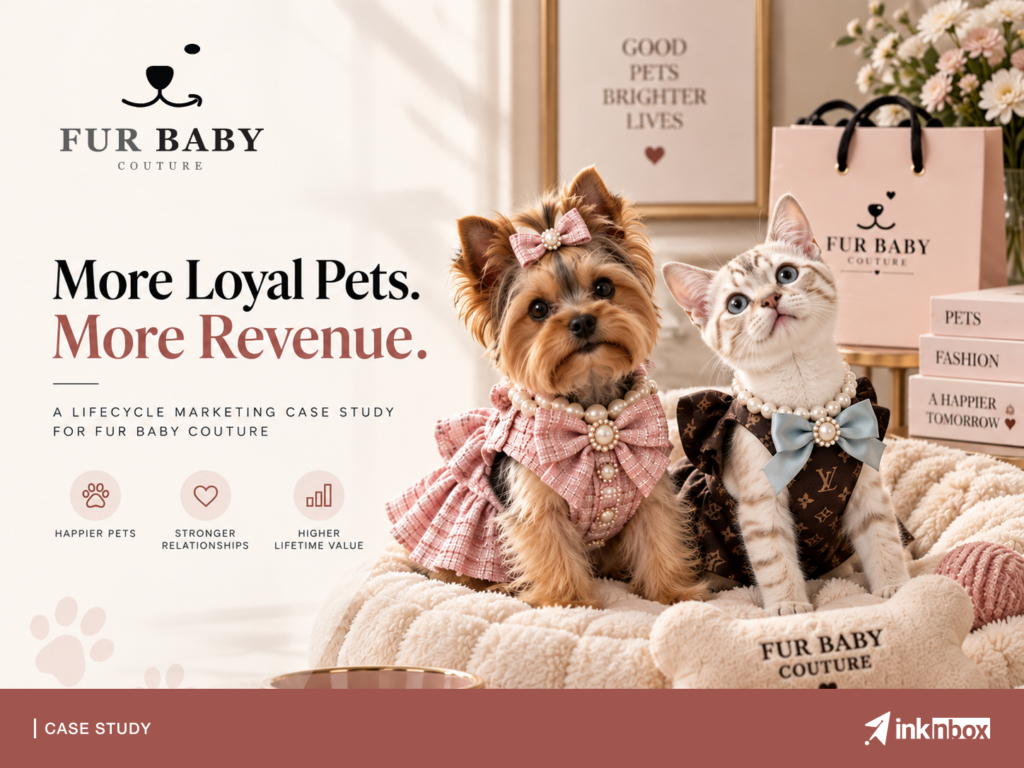
A strategic “What If” lifecycle marketing case study for Fur Baby Couture
Independent case study disclaimer This is an independent strategic case study created by inknbox. inknbox does not claim to manage Fur Baby Couture, and this document is not intended to criticize the brand, its internal team, or any current agency partner. It is a hypothetical model based on public-facing brand information and strategic lifecycle assumptions; it does not rely on private analytics, customer data, commerce backend access, Klaviyo data, or ad account data. The revenue percentage used in this case study is a directional scenario, not a guarantee or forecast. |
Fur Baby Couture already has many of the ingredients that make lifecycle marketing powerful: a broad product ecosystem, strong emotional purchase motivation, seasonal merchandising, visible social proof, and natural reasons for customers to buy again across apparel, accessories, travel, home, and occasions.
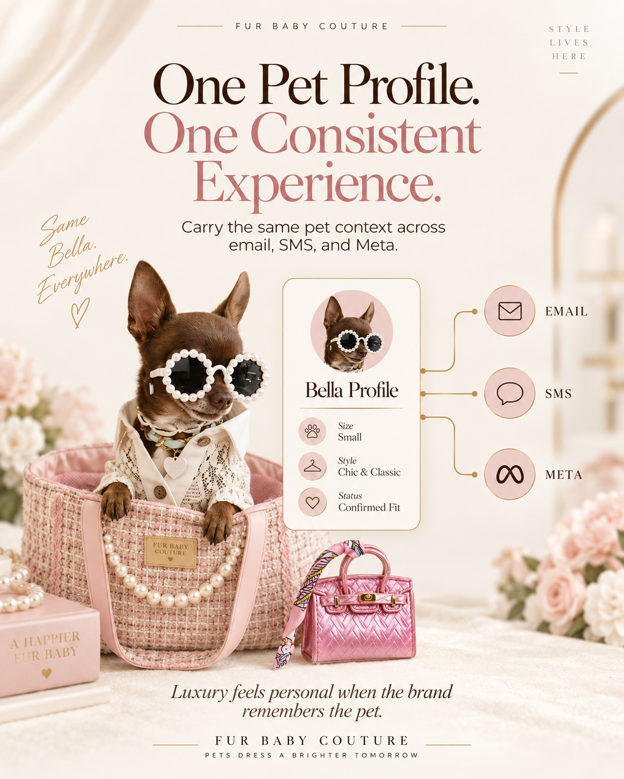
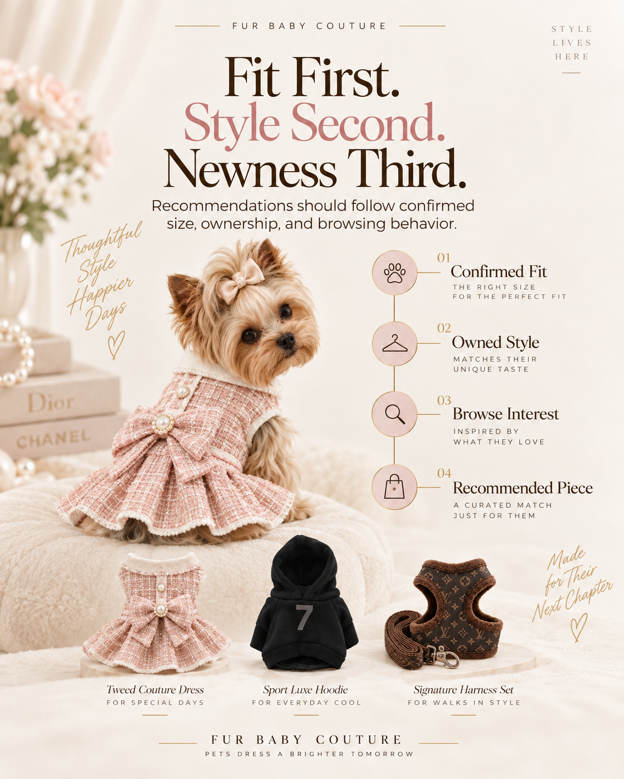
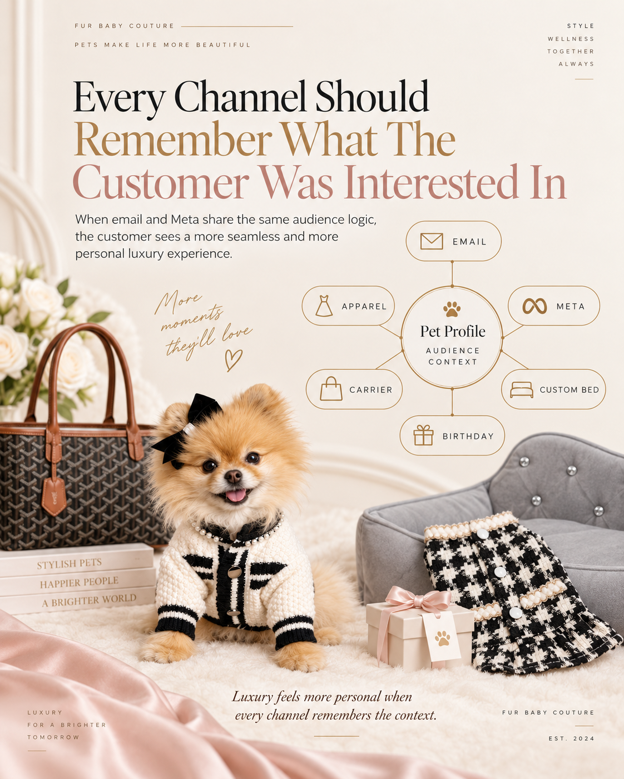
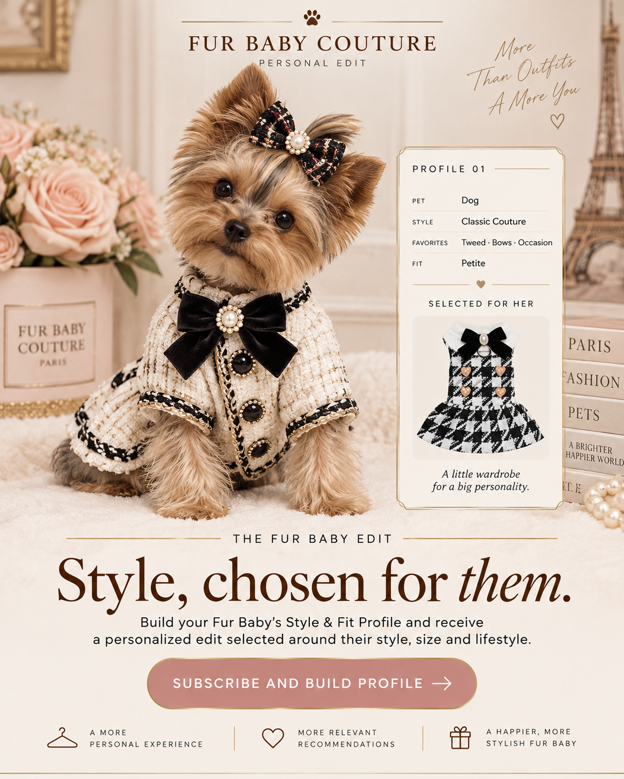
The strategic opportunity is not simply to send more campaigns. It is to make the customer relationship remember the individual pet behind the purchase – name, pet type, size, fit history, style preference, previous wardrobe, occasion timing, and category intent.
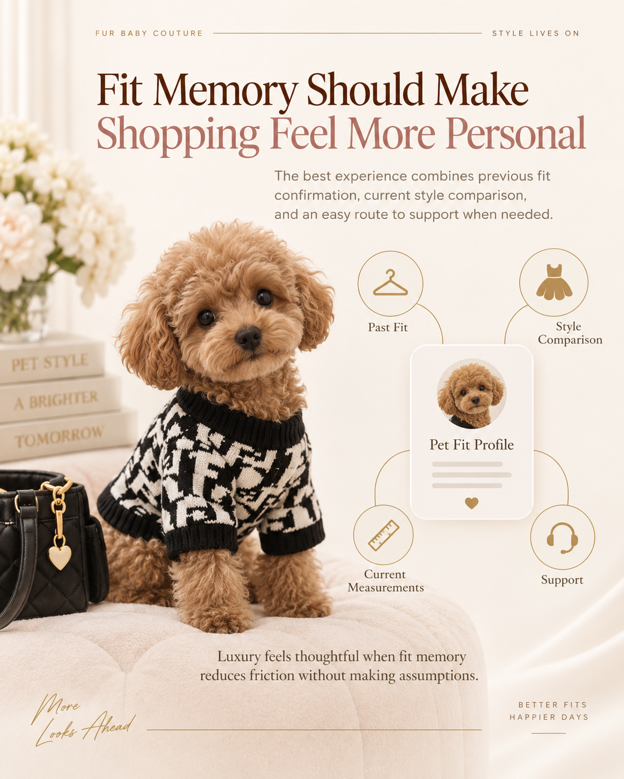
The central question: What if Fur Baby Couture moved from marketing to generic pet owners to building a persistent Pet Profile for each fur baby – so every email, SMS, recommendation, restock alert, and paid retargeting message knew who the shopper was actually buying for?
Overview
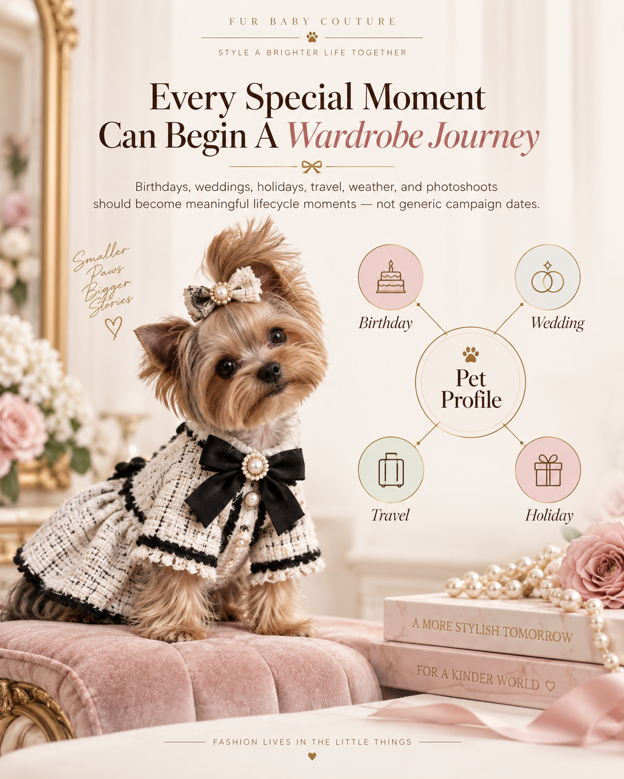
Fur Baby Couture is unusually well suited to a lifecycle model because the assortment supports multiple purchase roles rather than one narrow repeat cycle. A customer can enter through a small accessory, return for seasonal apparel, add a harness or leash, move into travel with a carrier, and later consider a premium custom bed. Birthdays, adoption anniversaries, weddings, holidays, photoshoots, travel, and weather create additional reasons to return.
Growth Area | Lifecycle Opportunity |
New visitor conversion | Replace generic newsletter capture with a pet-profile-led signup experience that learns pet type, name, style and, progressively, fit data. |
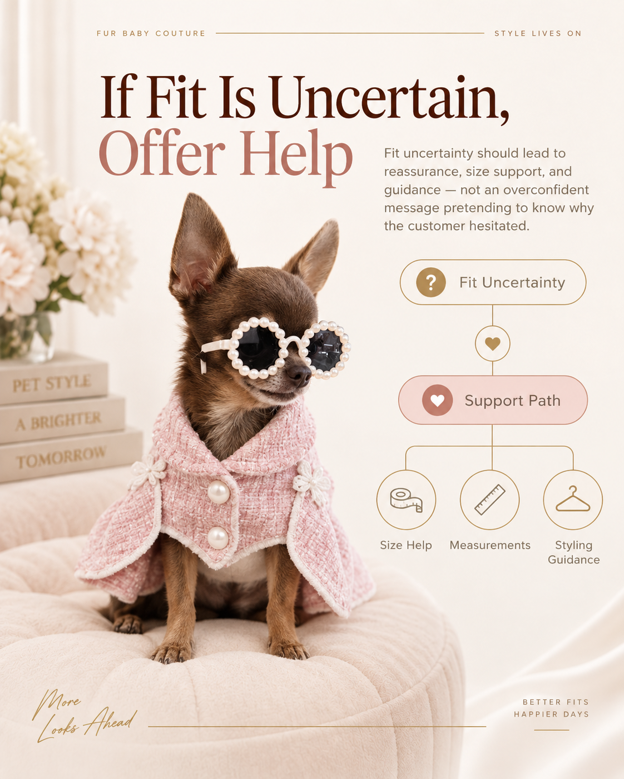
First purchase activation | Reduce apparel and carrier uncertainty with measurements, breed/size context, reviews, return/exchange reassurance, and product-specific guidance. |
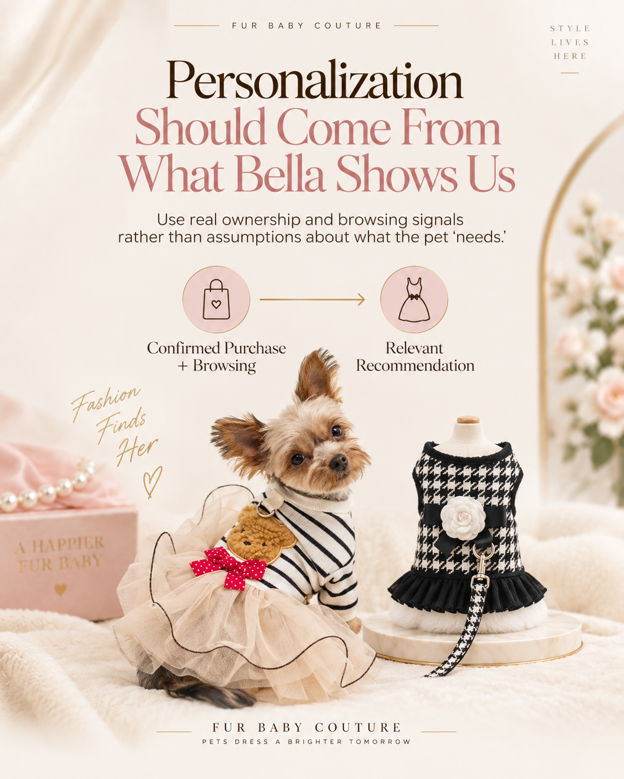
Repeat purchase growth | Use successful fit history, owned categories, style preference and occasion timing to recommend relevant next pieces instead of broad new-arrival grids. |
Loyalty / repeat-buyer growth | Recognize repeat pet parents with saved profiles, early access, personalized edits and premium treatment rather than relying only on discounts. |
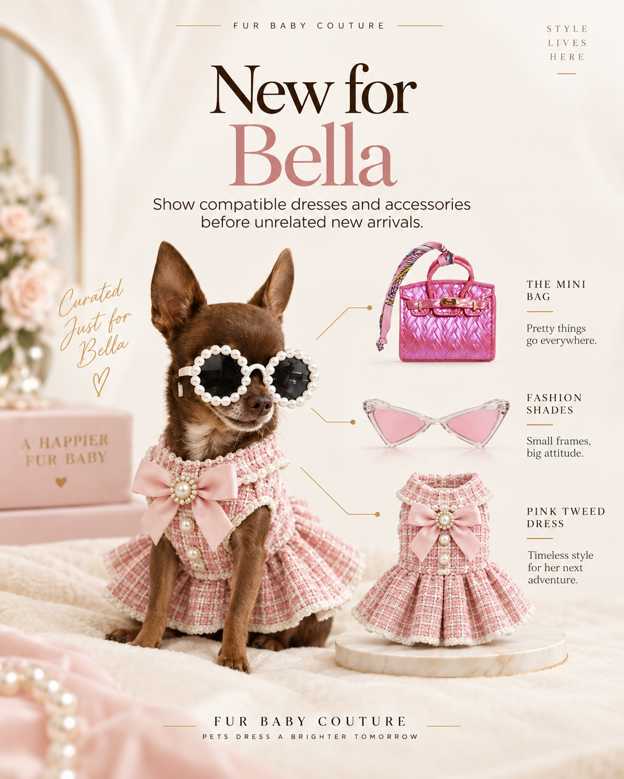
Average order value | Build complete looks and functional sets: dress -> bow/collar/accessory; harness -> leash -> carrier; carrier -> travel apparel; premium customer -> custom bed. |
Long-term retention | Use birthdays, adoption days, seasonal weather, travel, UGC and pet-specific wardrobe history as durable relationship triggers. |
Paid media efficiency | Sync behavioral and pet-profile segments to Meta so retargeting reflects the exact product, pet type, size, category, occasion and customer state. |
Klaviyo should function as the central lifecycle CRM rather than only as an email-sending platform. The strategic advantage comes from connecting first-party pet data, commerce events, product/variant history, service states, and campaign behavior into one customer record that can control email, SMS and Meta audiences.
Fur Baby Couture’s Background
Category | Details |
Brand positioning | Premium pet-fashion boutique combining playful luxury, editorial-style fashion and everyday comfort around the emotional bond between pets and owners. |
Core product type | Pet apparel, accessories, walking gear, travel products and premium home/lifestyle products. |
Main product categories | Apparel, dresses, hoodies/pullovers, outerwear, harnesses/leashes, carriers, beds and accessories; the site also organizes shoppers through Boy, Girl and Feline paths. |
Brand communication style | Playful, fashion-forward and personality-led, with couture references and humorous luxury-inspired product concepts. |
Customer behavior type | Identity- and emotion-driven shoppers who buy for a specific pet and can return across categories, seasons, occasions and lifestyle needs. |
Core revenue opportunity | Turn single purchases into pet-specific wardrobe relationships through fit memory, category expansion, event timing, size-specific availability, UGC and premium upgrades. |
Audience characteristics | Pet parents who treat pets as family members and enjoy expressing personality through fashion, travel and home accessories. |
Marketing opportunity | Persistent Pet Profiles that translate browsing and purchase behavior into pet-specific recommendations instead of generic segmentation. |
Retention potential | High: the category is naturally seasonal, occasion-led, socially shareable and expandable across functional and fashion categories. |
Ideal automation structure | Pet identity + fit confidence + product intent + occasion timing + service-state suppression + cross-channel retargeting. |
Public product examples in the supplied audit span accessible items such as Cat Eye Sunnies, Barkin Purse, Furbaby Harness and Classic Coco Dress through carriers and a high-ticket Custom Car Dog Bed. That price ladder gives lifecycle marketing room to support both repeat wardrobe purchases and premium category progression without assuming customers must repurchase the same SKU.
The Core Growth Hypothesis
Our hypothesis is simple Fur Baby Couture could unlock up to 40% additional lifecycle-driven revenue in a hypothetical optimized state if its customer journey were rebuilt around persistent Pet Profiles, fit confidence, product/category intent, occasion timing, size-specific availability, cross-sell logic, UGC/referral loops, and email/SMS/Meta coordination. The impact would need to be validated against real baseline data and retained-order economics. |
Revenue Lever | Expected Role |
Welcome flow optimization | Capture pet identity and first-party preference data early, then convert with a relevant first-category edit rather than a generic bestseller push. |
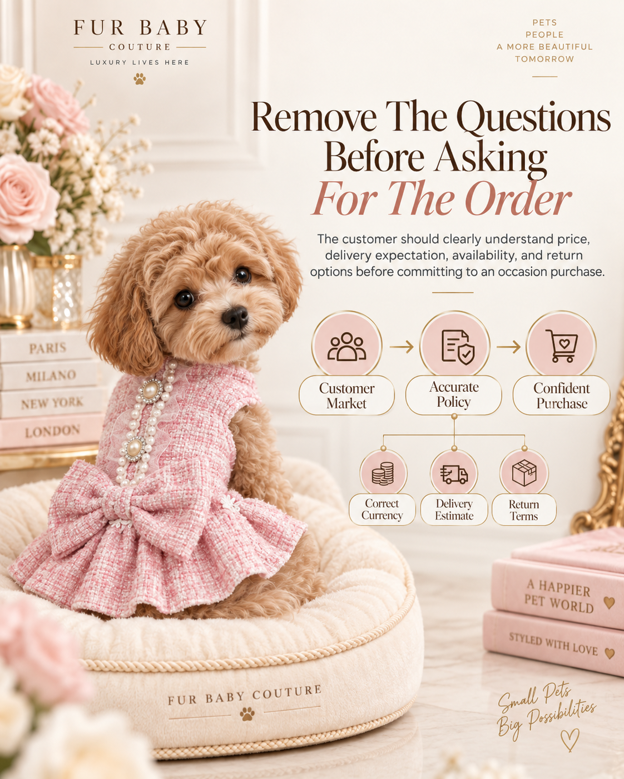
Browse + checkout recovery | Resolve the actual objection by category: fit for apparel, dimensions for carriers, customization/timeline for custom beds, and availability for exact variants. |
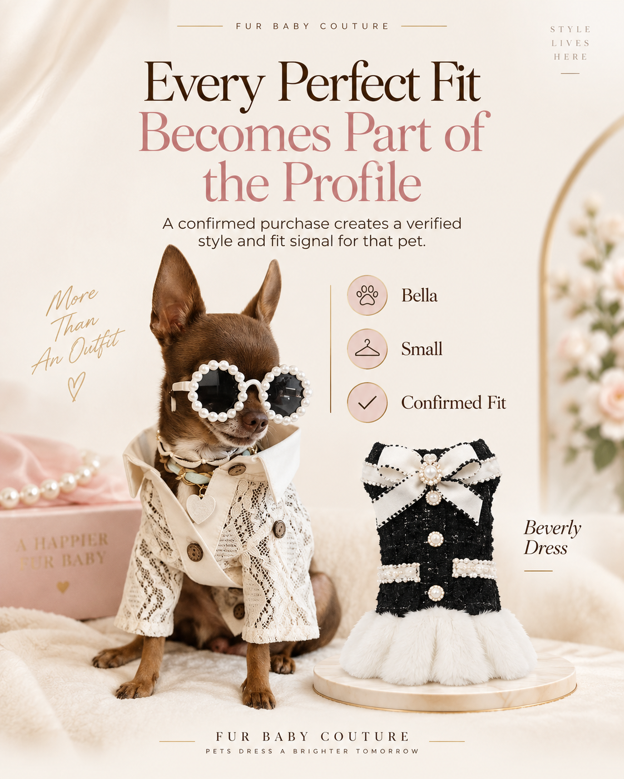
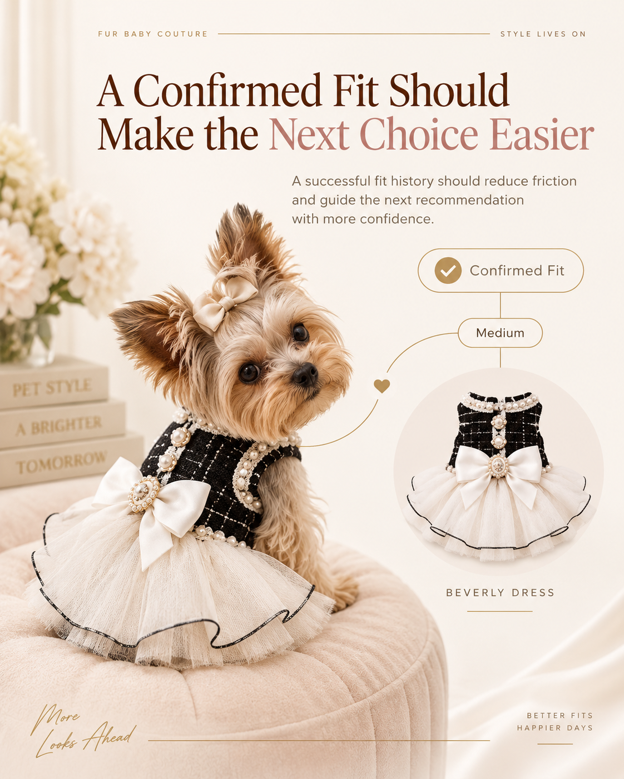
Post-purchase fit confirmation | Turn a delivery into a known successful fit – or a service case – before asking for another purchase. |
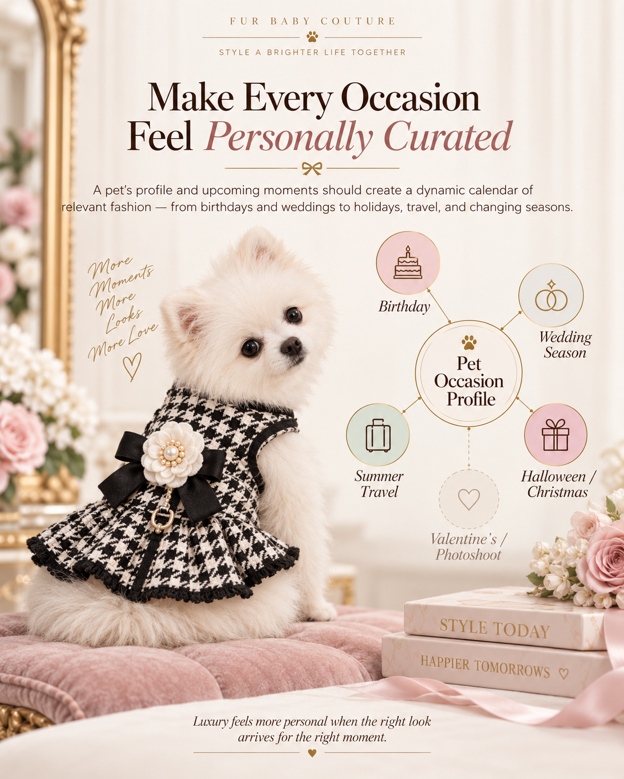
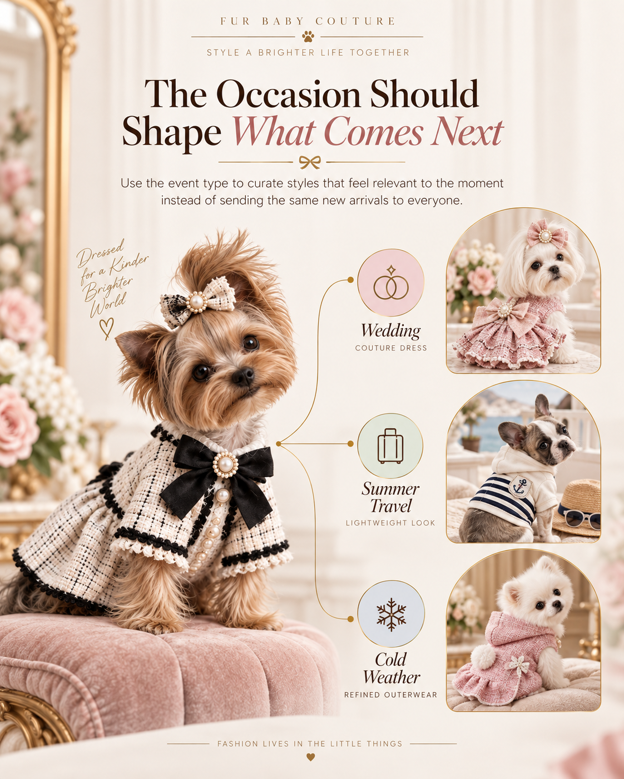
Occasion / repeat-purchase automation | Create natural return moments around birthdays, adoption days, holidays, weddings, weather and travel. |
Repeat-buyer / VIP progression | Use saved pet profiles, successful fit history and full-price behavior to create recognition and early-access treatment. |
Cross-sell and set logic | Expand from one category into complete looks or functional sets based on what the pet already owns. |
SMS reminders | Use opt-in SMS for size-specific restocks, birthdays, high-intent checkout, new collections and order/custom-product updates. |
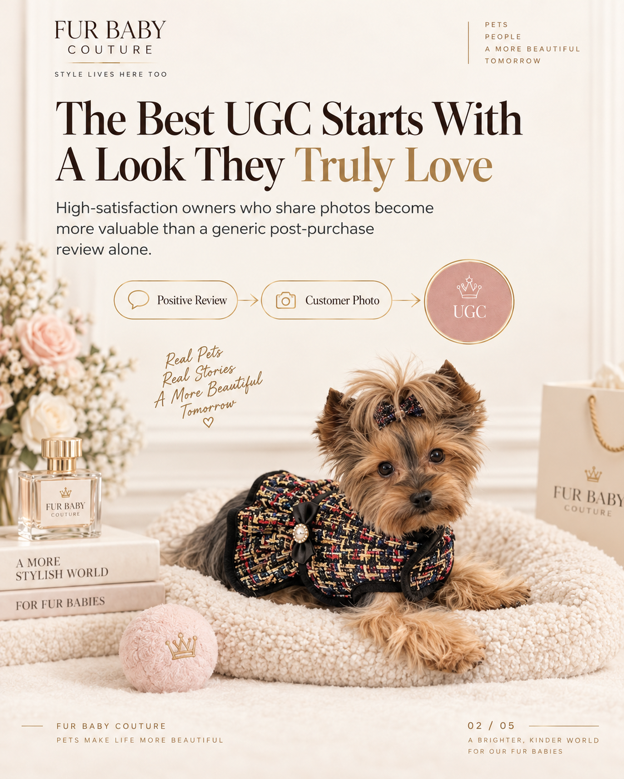
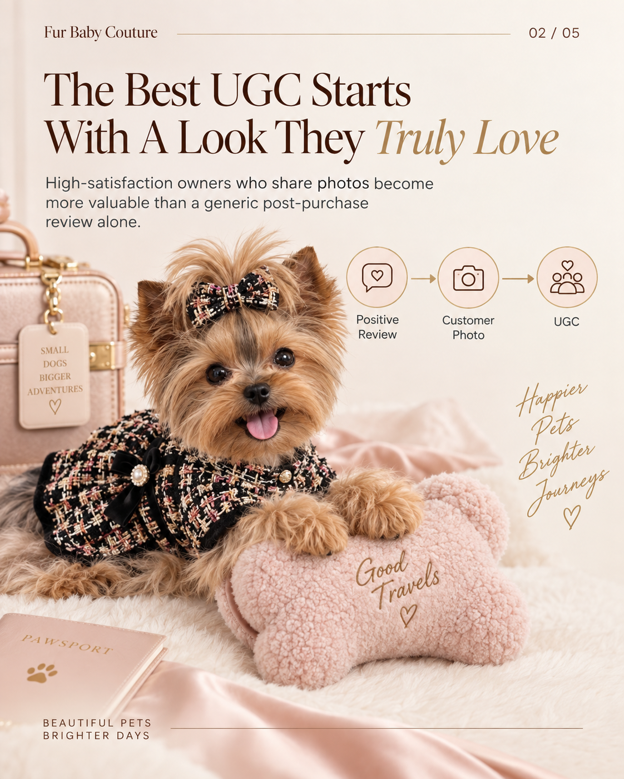
Referral + UGC | Turn happy pet parents and customer photos into social proof and lower-cost acquisition. |
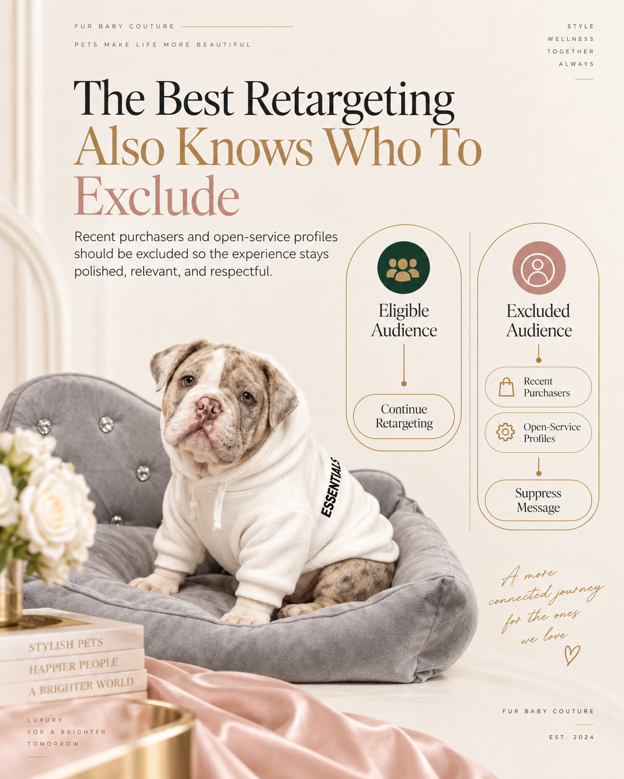
Meta retargeting | Mirror exact-product and Pet Profile logic in paid retargeting while suppressing recent purchasers and open service cases. |
Winback + sunset | Re-engage with pet/category relevance, then protect deliverability when long-term disengagement is clear. |
The value would come from the combined effect of these systems. No single flow should be presented as the source of the full scenario uplift.
Priority-Based Tools & Automation Infrastructure
Layer | Tool / System | Purpose |
Core CRM | Klaviyo | Email, SMS, flows, segmentation, campaign orchestration and dynamic content. |
Commerce data | Existing storefront / commerce platform | Orders, SKU/variant data, product views, cart/checkout events, stock status and customer purchase history. |
Customer data layer | Klaviyo profile properties | Pet name/type, breed, measurements, successful size by category, fit status, style preference, birthday/adoption date, category affinity, market and lifecycle state. |
Automation logic | Klaviyo flows + commerce events | Route customers by exact product, size, purchase history, service state, occasion and engagement. |
Review / UGC layer | Review + UGC capture system | Collect fit feedback, reviews, customer photos, social permissions and advocacy signals. |
Analytics | Klaviyo analytics + GA4 + commerce reporting | Measure flow revenue, retained-order contribution, repeat rate, returns/exchanges, AOV, LTV and segment performance. |
Retargeting | Meta custom audiences | Retarget email/SMS subscribers, browsers, checkout abandoners, occasion segments, repeat buyers and lapsed customers. |
Lead capture | Popups, profile landing pages, quiz/lead forms | Grow owned audiences while collecting useful first-party pet preferences. |
Referral | Referral / loyalty tool | Friend offer, referrer credit and advocacy tracking after verified positive customer moments. |
The highest-value profile properties should include pet_name, pet_type, breed, weight, chest_measurement, neck_measurement, typical_size, successful_size_by_category, fit_confirmed, style_preference, birthday_or_adoption_day, favorite_category, market, full_price_or_sale_tendency, SMS consent, UGC/review status, and active_return_or_service_case.
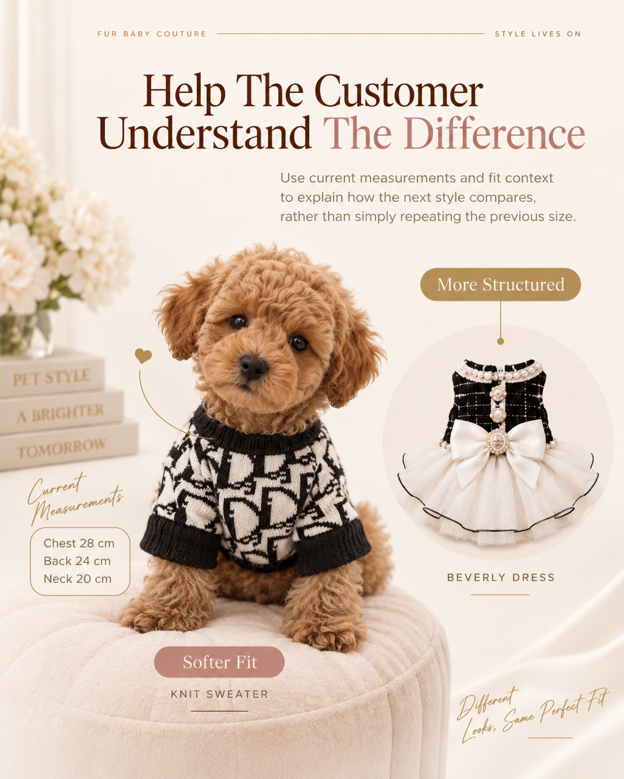
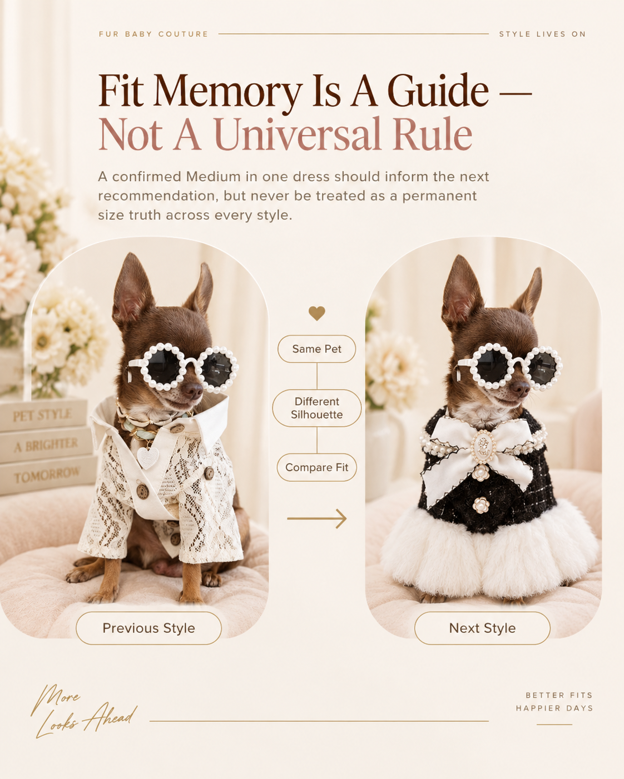
Product and variant logic matter because a “Small” in one dress should not be treated as a universal fit recommendation across every product. The system should remember successful size history while still surfacing the current product-specific measurement guide.
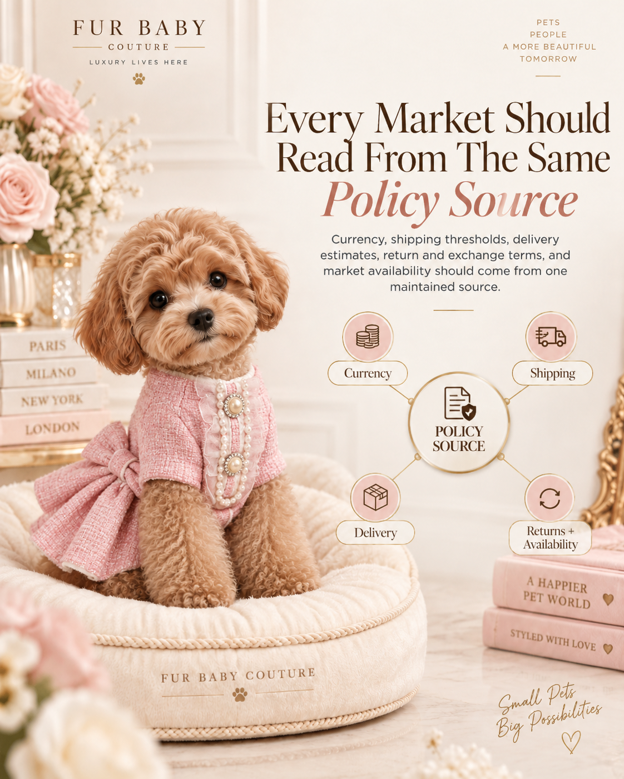
Critical prerequisite: one controlled source of truth The supplied audit identified visible inconsistencies across product attributes, returns language and shipping thresholds/timing. Before advanced automation, product feeds, email modules and recovery flows should pull from one governed source for sizing, materials, shipping, returns and availability. Automation scales accuracy – but it also scales inconsistency if the underlying data is wrong. |
Lifecycle Architecture Design
Lifecycle Stage | Main Goal | Strategy |
Acquisition | Capture new leads and useful first-party pet data | Pet-profile popups, fit/style lead capture, paid lead forms and optional SMS for requested alerts. |
Activation | Convert subscribers and first-time buyers | Welcome education, product-specific fit confidence, reviews, category guidance and relevant first-purchase recommendations. |
Retention | Create successful ownership and natural reasons to return | Post-delivery fit confirmation, care/support, size memory, occasion automations, back-in-stock and repeat wardrobe edits. |
Expansion | Increase customer lifetime value without losing relevance | Complete looks, functional sets, premium category upgrades, VIP recognition, UGC/referral and cross-channel retargeting. |
Customers should move through the system based on what they viewed, what they added to cart, the exact size/variant selected, what they purchased, whether the fit was successful, what their pet profile says, whether an occasion is approaching, whether the selected size is in stock, whether a return/exchange is unresolved, how they engage with email/SMS, and whether they should be included or excluded from paid retargeting.
Lead Capture Strategy
Website Popup System
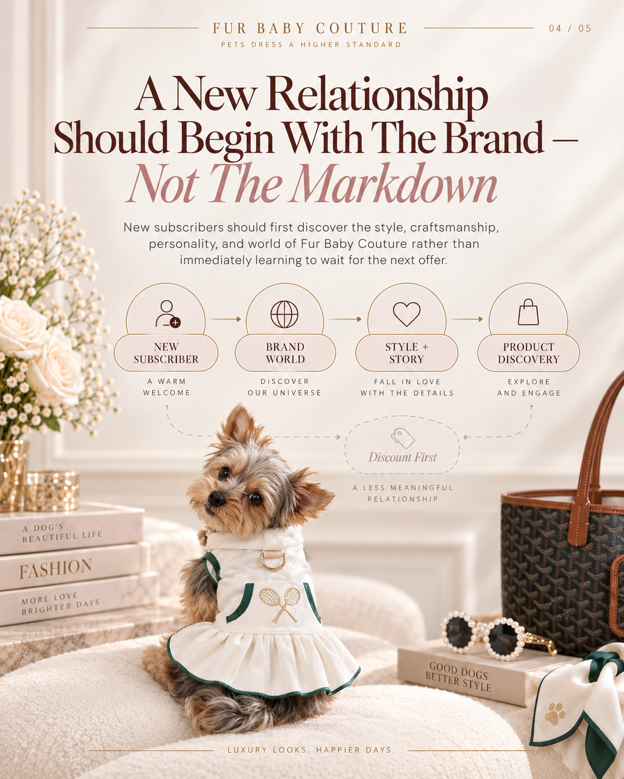
The popup system should feel like a concierge for a specific fur baby, not a generic discount box. Because the storefront already leans on visible discount merchandising, the primary acquisition promise should create usefulness and personalization first.
Visitor Behavior | Lead Capture Strategy |
First-time visitor | “Build your fur baby profile” – capture email first, then progressively ask pet type, name and style preference. |
Apparel / dress browser | Offer fit help: save pet measurements or receive a sizing + style edit for the exact category. |
Carrier browser | Offer a travel-fit guide and personalized carrier edit based on pet size and intended use. |
Returning visitor | Recognize known pet profile and offer to continue the edit for that pet. |
Exit-intent visitor | Offer a personalized Fur Baby Style & Fit Edit by email rather than defaulting immediately to another discount. |
Email + SMS signup | Use SMS only with separate consent for high-value alerts such as exact-size restock, birthday reminders, high-intent checkout or custom-order updates. |
Example popup copy Headline: Build Their Fur Baby Profile
Supporting copy: Tell us who you shop for – their name, style and fit – and we will make future edits more relevant.
CTA: Build My Fur Baby’s Profile |
SMS consent should be explicit, channel-specific and market-appropriate. A checkout phone number should not automatically be treated as permission for promotional text messaging.
Paid Ads Lead Capture Landing Page
For low-budget Meta acquisition, the strongest first-party-data offer is a personalized Style & Fit Profile rather than another blanket discount. The landing page can position the email signup as a softer first conversion for pet parents who like the brand but are not ready to purchase immediately.
- What the Pet Profile does: remembers who the customer shops for.
- Pet type, name and styling preference as the first progressive fields.
- Optional fit inputs such as breed, weight or measurements after email capture.
- A personalized category edit: dresses, harnesses, travel, accessories or feline.
- Email delivery of the edit, with optional SMS for exact-size restocks and time-sensitive occasions.
- Best-seller or category CTA only after the profile value is clear.
The commercial goal is not only immediate purchase. It is to turn paid traffic into an owned profile that can be nurtured in Klaviyo without paying for every future touchpoint.
Referral Program
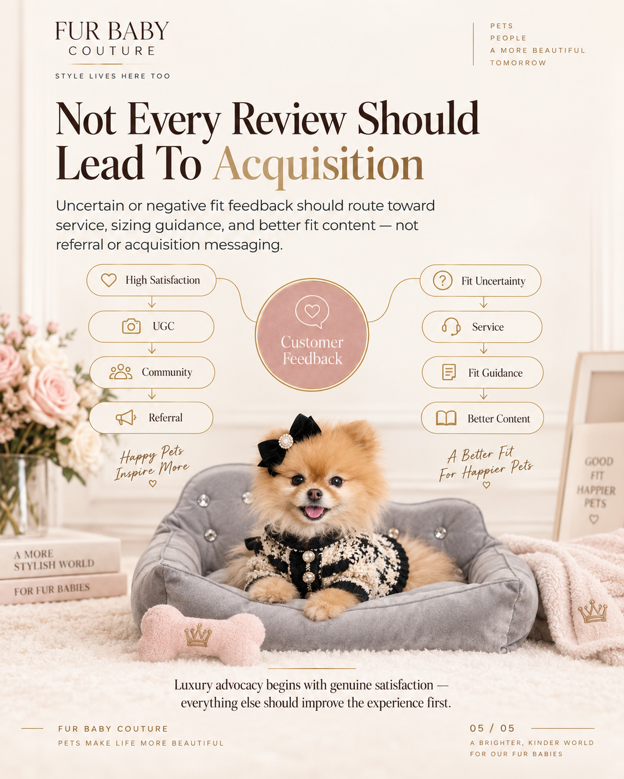
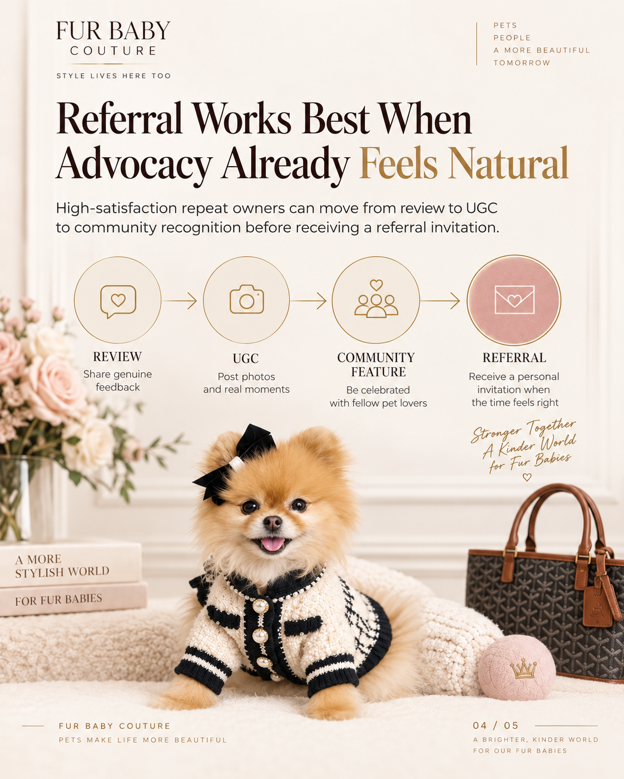
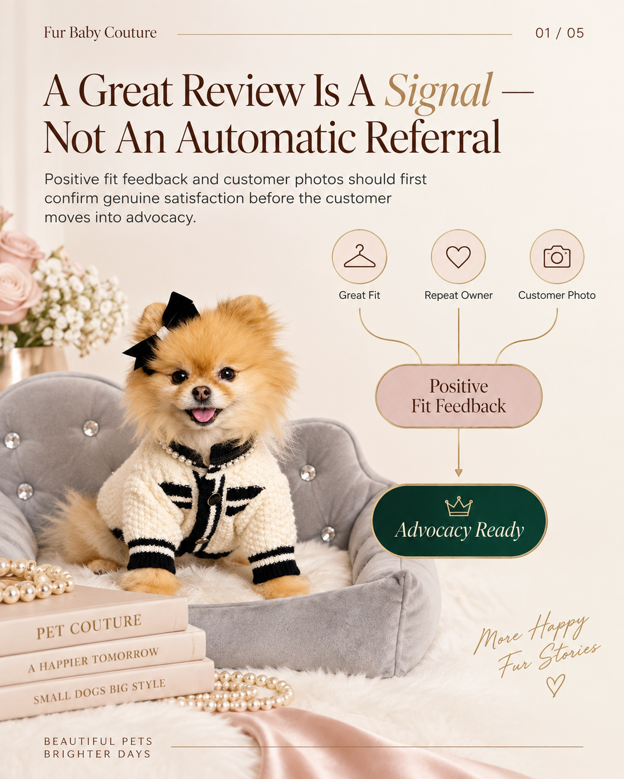
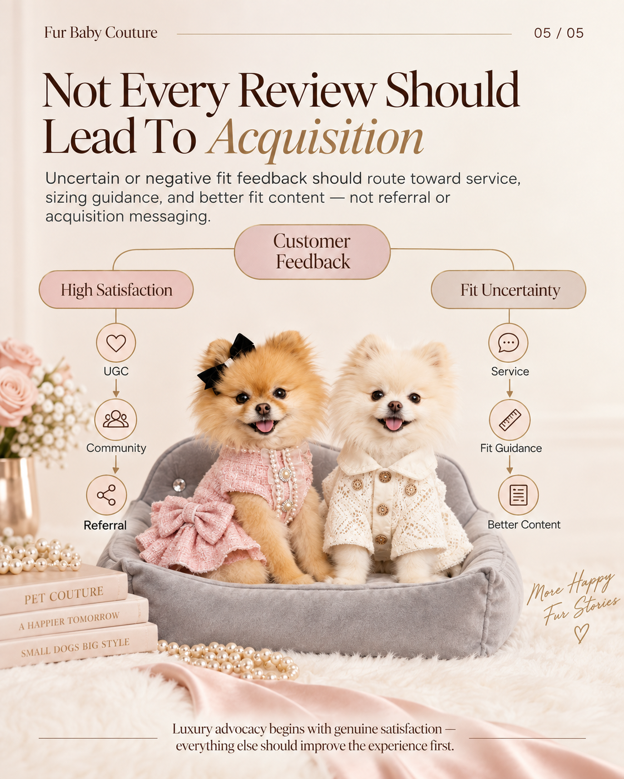
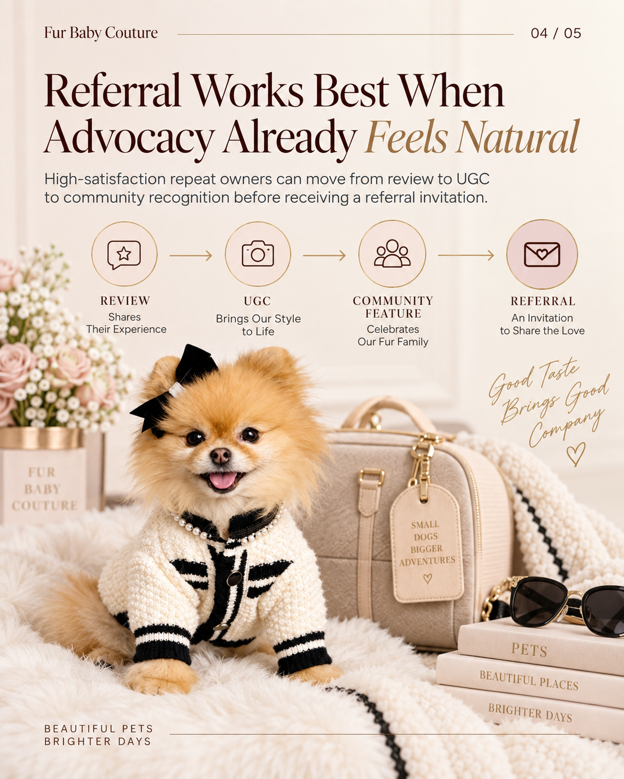
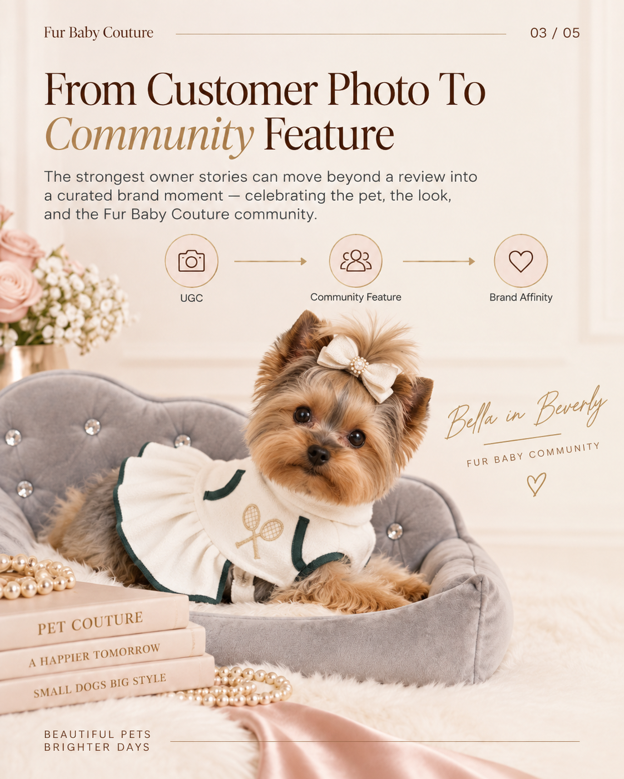
A referral program should activate after satisfaction is visible, not immediately after checkout. The structure below is a hypothetical test designed to match a fashion-led, social category.
User Type | Proposed Test Offer |
Referred friend | 15% off a first order after joining through the referral link. |
Existing customer | A $15 store credit after the referred friend completes a qualifying purchase. |
Best triggers: successful fit confirmation, positive review, UGC submission, second purchase, VIP qualification, a completed birthday/occasion purchase, or a high-satisfaction custom-product delivery.
Referral message Your fur baby gets compliments for a reason. Share Fur Baby Couture with another pet parent – they receive a first-order welcome, and you receive a thank-you credit when they shop. |
Core Klaviyo Flow System
The flow system should not be generic. Every core sequence should use pet identity, exact product/category, size/variant, successful fit history, event timing, regional policy and service-state logic wherever the data is available.
Recommended lead offer Build Your Fur Baby’s Style & Fit Profile – tell us who you shop for and receive a personalized edit by pet type, style, category and fit context. |
Campaign Element | Strategy |
Audience | Cold and warm pet-fashion audiences; website/video engagers; category-specific creative for dog, cat, apparel, travel and occasion interests. |
Offer | Personalized Style & Fit Profile / Fur Baby Edit delivered by email; discount is optional as a secondary test, not the core promise. |
Landing page | Explain the value of remembered pet identity, saved fit context and relevant future edits; show examples of personalized recommendations. |
Form fields | Email first; then pet name, dog/cat, styling preference; progressive optional fit and occasion data. SMS only as separate consent for useful alerts. |
Follow-up flow | Welcome + Pet Profile flow with relevant category routing. |
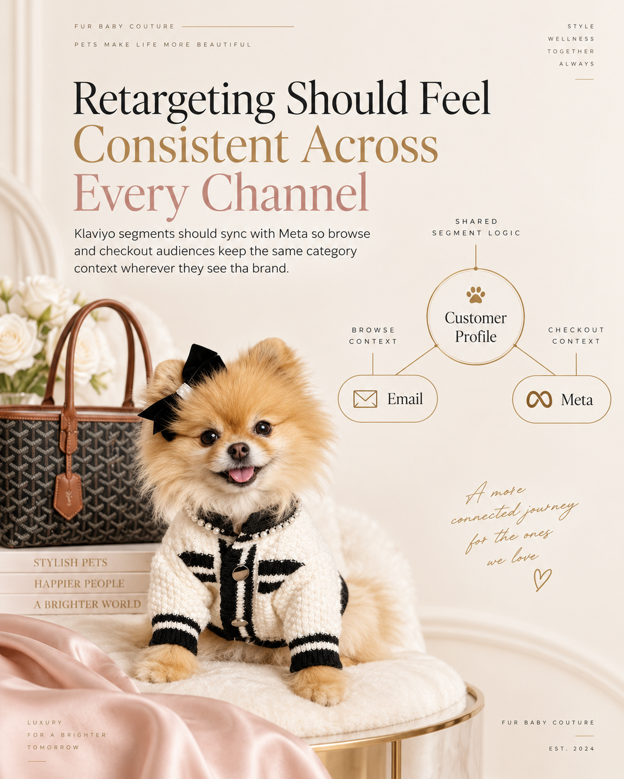
Retargeting layer | Klaviyo segments sync to Meta so non-buyers see product/category-specific follow-up instead of restarting with generic prospecting. |
Ad angle examples:
- “Your dog has a style. Your inbox should know it.”
- “Find the fit before the outfit – build your fur baby profile.”
- “Shopping for a birthday, wedding or travel? Build their edit first.”
- “Dog, cat, glam, sporty or cozy – get a Fur Baby Couture edit built around them.”
Meta Ads Retargeting Strategy
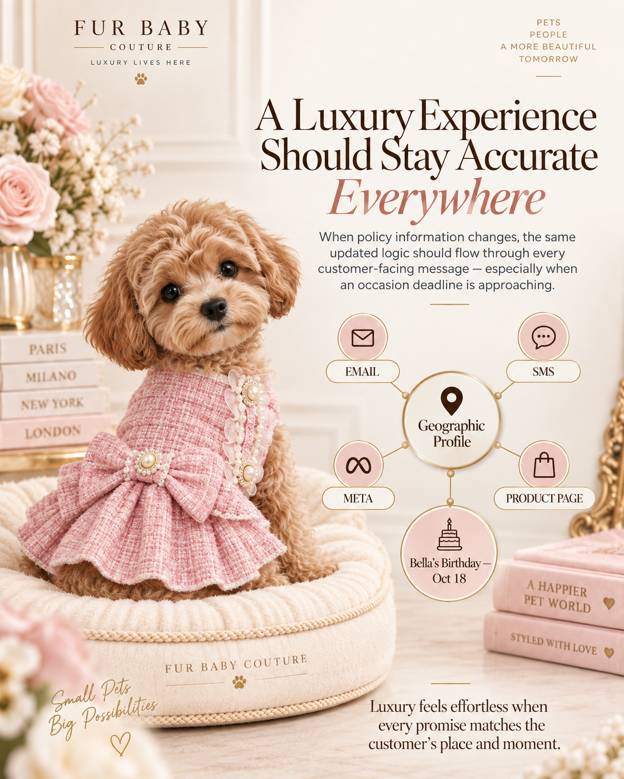
The goal is to make paid media behave like an extension of the lifecycle system. Klaviyo segments should sync with Meta audiences, with hard exclusions for recent purchasers, active service cases, unsupported variants and unsubscribed/suppressed profiles where appropriate.
Klaviyo Segment | Meta Retargeting Angle |
Email subscribers, no purchase | Pet-profile value, fit guidance and category-specific first-purchase education. |
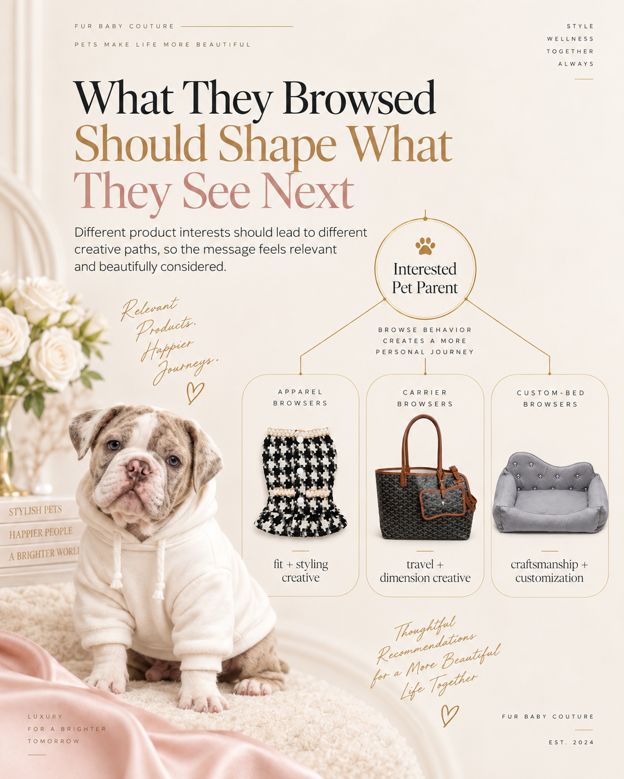
Dress / apparel browsers | Exact product or category creative focused on fit, comfort, styling and UGC. |
Carrier browsers | Travel fit, dimensions, pet-size suitability and lifestyle imagery. |
Custom-bed browsers | Customization, craftsmanship, process and high-touch support. |
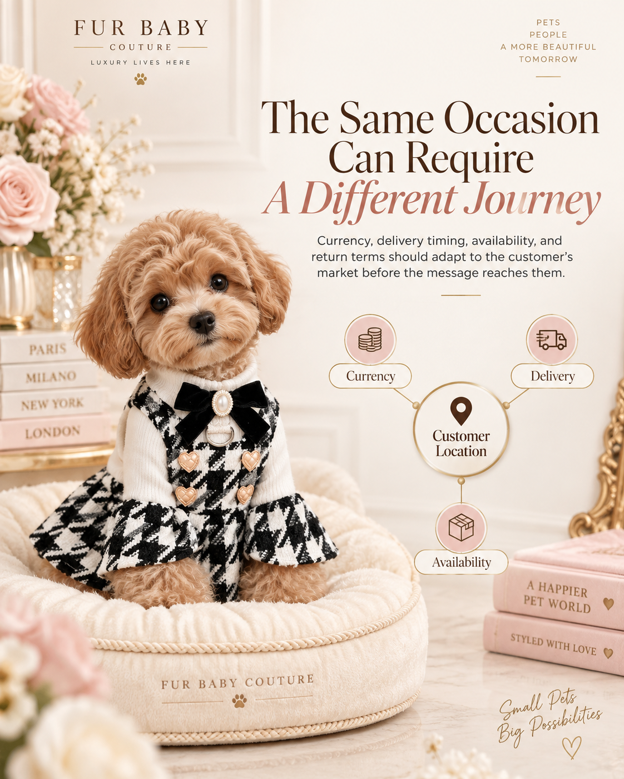
Checkout abandoners | Exact product + selected size/variant + truthful availability; no generic coupon-first creative. |
Size-specific waitlist | Back-in-stock creative only while the exact variant is available. |
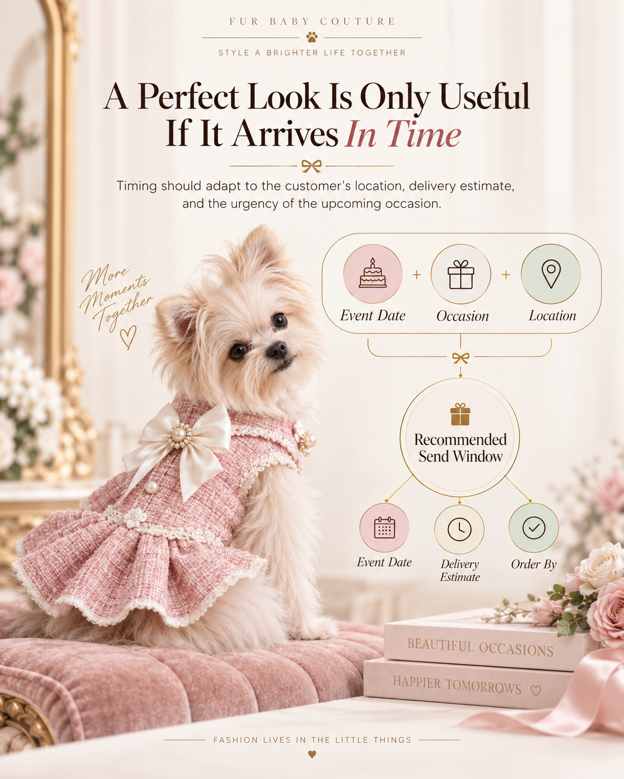
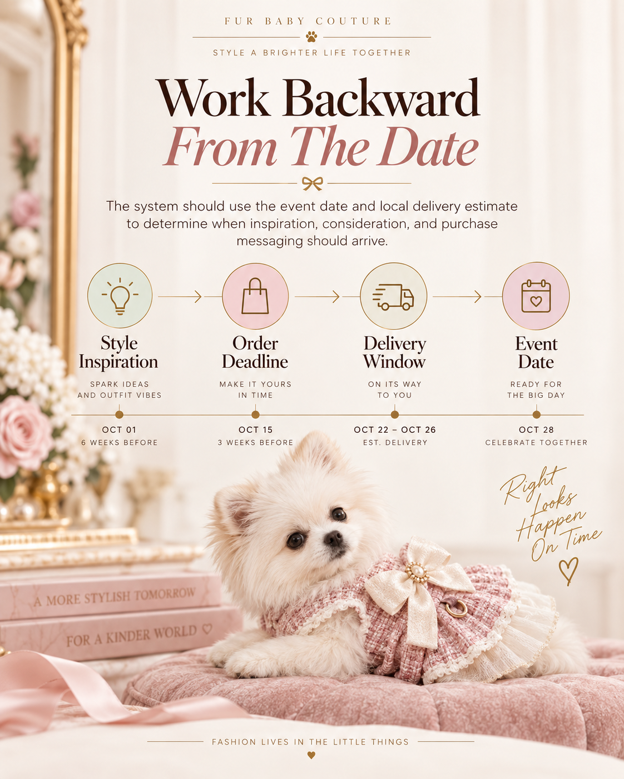
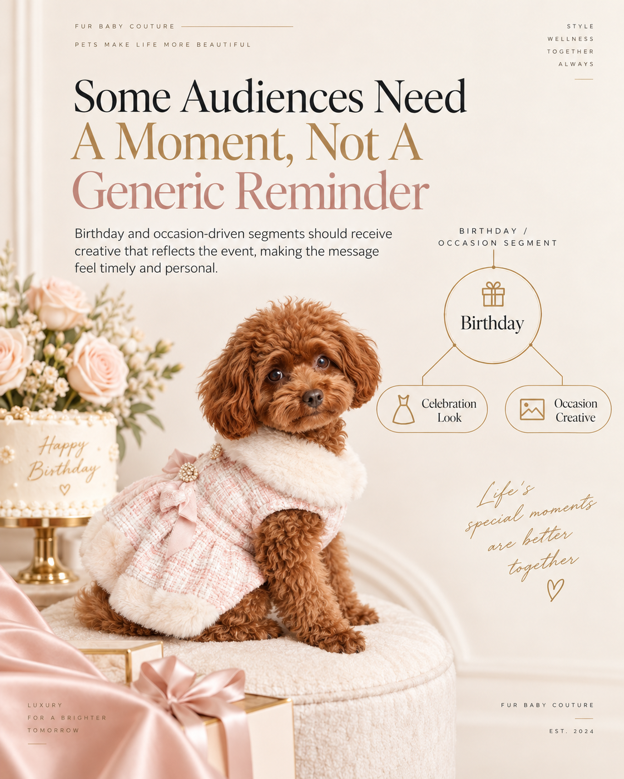
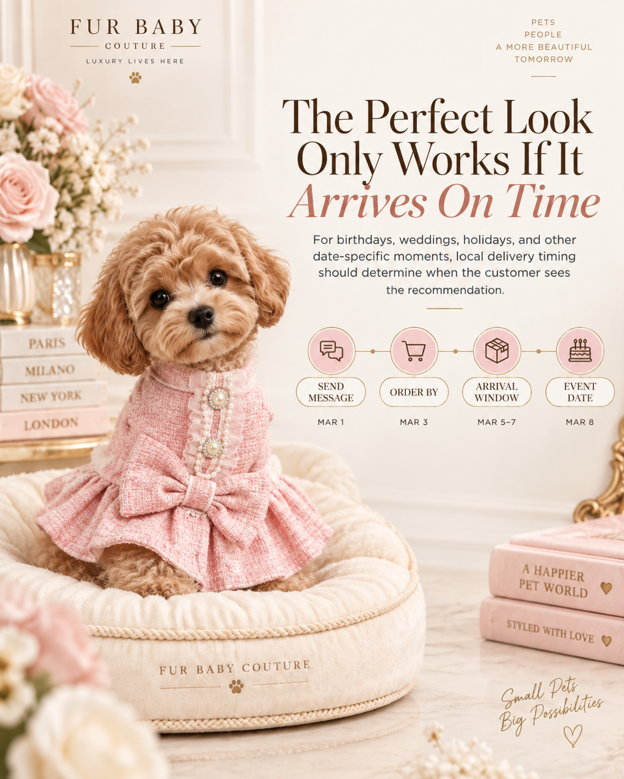
Birthday / occasion window | Event-specific creative with sufficient delivery time. |
Repeat buyers | Complete-look, category expansion or premium edit based on owned products. |
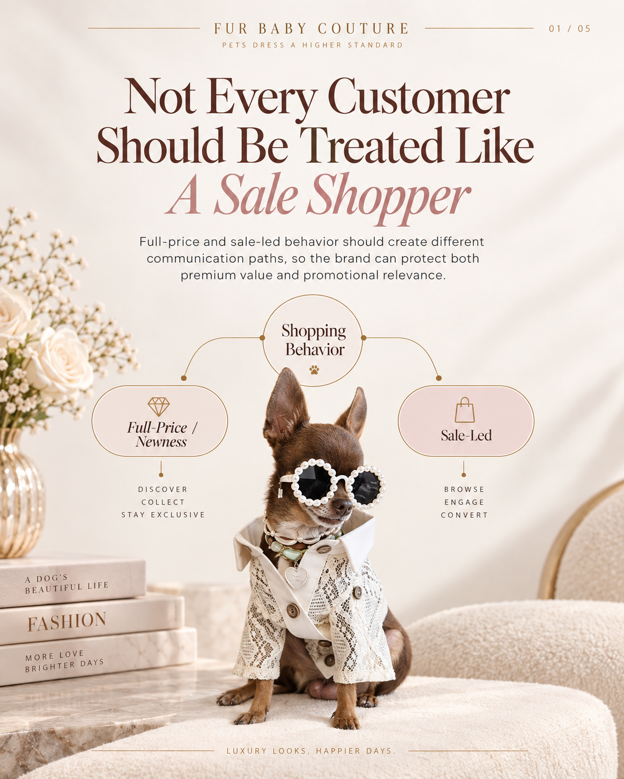
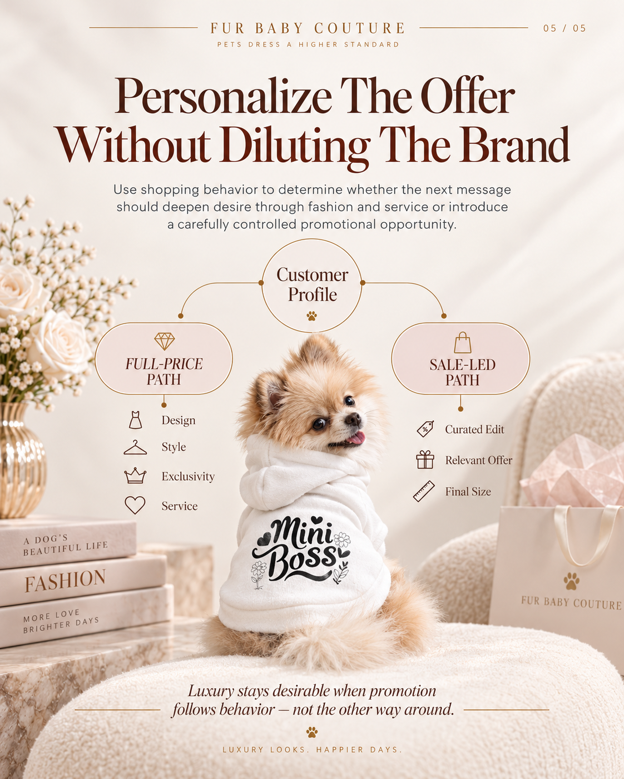
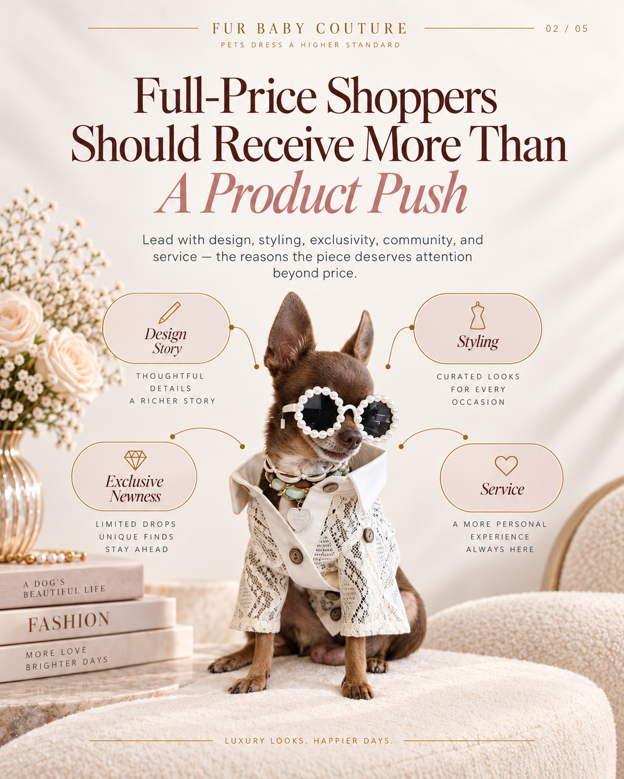
VIP / full-price buyers | Early-access and premium product stories; avoid discount-heavy creative. |
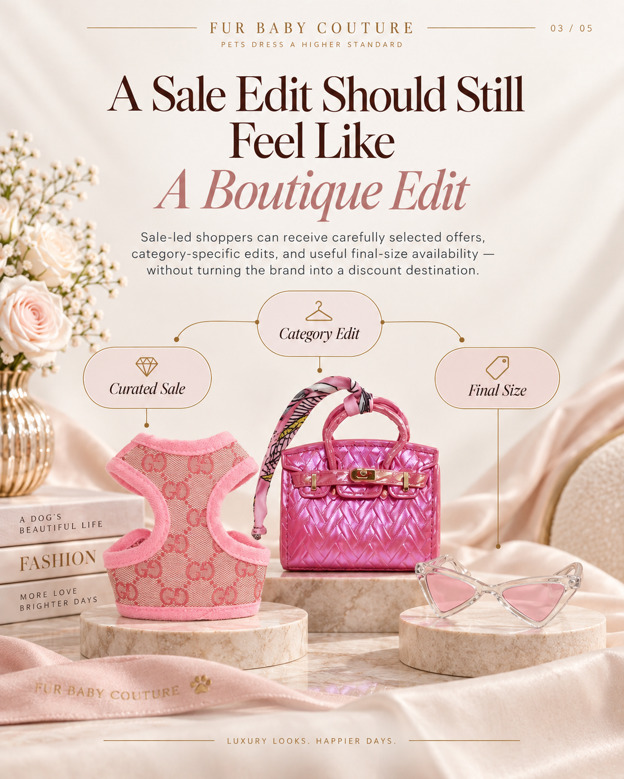
Sale-led buyers | Controlled sale/last-size creative without contaminating full-price audiences. |
Lapsed buyers | Pet-specific reintroduction, community content, seasonal relevance and updated profile prompt. |
UGC advocates | Community features, referral and look-based discovery rather than first-purchase ads. |
[Image Placeholder: Klaviyo-to-Meta audience sync with recent-purchase and service-state exclusions] |
Referral Program Strategy
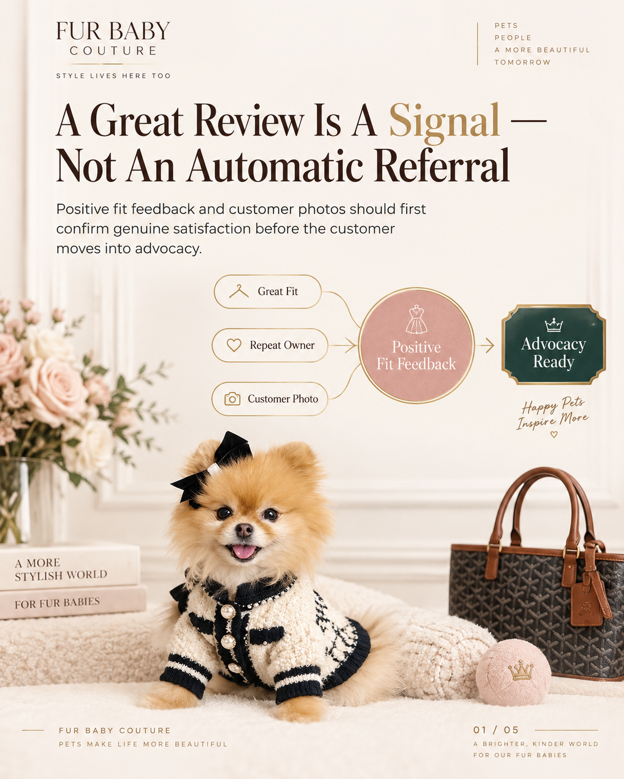
Referral should be part of the customer journey after satisfaction is evident, not hidden in the footer and not triggered blindly after purchase.
Person | Proposed Incentive |
Friend | 15% off first order through a qualifying referral link. |
Referrer | $15 store credit after the friend completes a qualifying purchase. |
Trigger | Why It Works |
After successful fit confirmation | The customer knows the product works for their pet. |
After positive review | High-satisfaction moment with explicit proof. |
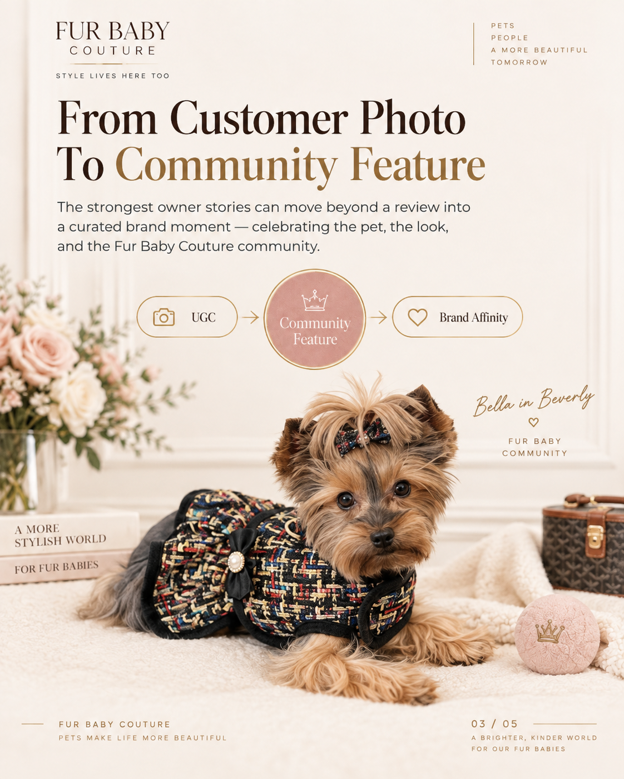
After UGC submission | The customer is already advocating publicly. |
After second retained purchase | Repeat behavior signals trust in the brand. |
After VIP qualification | High-value advocates can introduce similar customers. |
After a successful birthday/occasion purchase | Emotion and social sharing are naturally high. |
After custom-product satisfaction | High-touch experience creates a strong story worth sharing. |
Referral message Bella has a look people notice. Share Fur Baby Couture with another pet parent – give them a first-order welcome and earn a thank-you credit when they shop. |
Expected Revenue Impact
Based on the lifecycle system outlined above, a hypothetical optimized state could support up to 40% additional lifecycle-driven revenue through better first-purchase conversion, fit confidence, repeat wardrobe behavior, occasion timing, cross-sell, size-specific restock recovery, UGC/referral and email/SMS/Meta alignment. This is a directional case-study scenario, not a guaranteed outcome; real potential should be measured against Fur Baby Couture’s baseline data and retained-order economics.
Growth Lever | Potential Impact |
Welcome + Pet Profile | Higher-quality first-party data and more relevant first-purchase journeys. |
Browse + checkout recovery | More recovered high-intent revenue through product-specific objection handling. |
Post-purchase fit confirmation | More successful retained purchases, better fit intelligence and fewer mistimed cross-sells. |
Occasion automation | More repeat purchases around birthdays, holidays, travel, weddings and weather. |
Back-in-stock automation | Recovered demand at exact size/variant level. |
Repeat-buyer / VIP progression | Higher LTV through saved-fit convenience, early relevance and premium treatment. |
Cross-sell / complete looks | Higher AOV and category adoption. |
UGC + referral | More social proof and lower-cost acquisition from satisfied customers. |
Meta retargeting | Better paid efficiency from behavior- and pet-specific audiences. |
Sunset suppression | Better deliverability, cleaner engagement and lower list drag. |
KPI | Why It Matters |
Lifecycle / email revenue contribution | Measures overall owned-channel contribution without treating attribution as the only measure. |
Flow revenue | Shows automation performance by journey. |
First purchase conversion rate | Measures welcome and lead-capture quality. |
Pet Profile completion rate | Measures whether first-party personalization data is actually being collected. |
Fit-confirmed retained order rate | Measures successful apparel/harness ownership after returns/exchanges. |
Return / exchange rate by product + size | Shows where fit friction is still hurting the journey. |
First-to-second retained purchase rate | Core retention metric for a durable-goods wardrobe model. |
Time between retained purchases | Tracks whether lifecycle timing improves natural return behavior. |
Birthday / occasion flow conversion | Measures event-based repeat-purchase value. |
Back-in-stock conversion by variant | Measures exact-size demand recovery. |
AOV | Measures complete-look and category-expansion impact. |
LTV | Measures total lifecycle success. |
Full-price vs sale revenue mix | Shows whether lifecycle marketing protects premium demand while still monetizing sale-led segments. |
UGC / review generation rate | Measures advocacy and creative supply. |
Unsubscribe / spam rate | Measures list health and relevance. |
Meta retargeting ROAS / incremental lift | Measures cross-channel efficiency, ideally with controls or holdouts where feasible. |
Where possible, commercial reporting should focus on retained revenue or contribution after refunds/returns rather than gross attributed sales alone. A purchase that is later returned should not be counted as lifecycle success in the same way as a successfully retained order.
90-Day Execution Roadmap
Conclusion
Fur Baby Couture already has the foundation of a compelling lifecycle brand: broad category depth, playful premium positioning, natural seasonal and occasion demand, strong emotional purchase motivation, highly shareable products, and a price architecture that can support both frequent smaller purchases and premium upgrades.
The largest growth opportunity is not simply acquisition – and it is not simply more email. The bigger opportunity is lifecycle infrastructure that remembers the individual pet and uses that memory responsibly.
If inknbox were responsible for the lifecycle strategy, we would build a retention engine around Pet Profiles, fit confidence, exact product and size data, successful ownership, occasion timing, service-state suppression, controlled sale logic, UGC, referral, SMS where useful, and Klaviyo-to-Meta retargeting.
That would allow the brand to convert more subscribers into first-time buyers, make apparel easier to shop, recover higher-intent carts, turn successful fit into reusable data, create natural reasons to return, build complete wardrobes and travel sets, recover exact-size demand, recognize high-value pet parents, generate more social proof, and improve paid-media relevance.
The lifecycle principle Not more random campaigns. Not more generic discounts. Build a customer journey that remembers who the customer is shopping for – and sends the next useful message for that fur baby. |